Boxador
The Boxador is 30 kilos of galloping joy - Boxer clowning welded to Labrador friendliness in a strong, short-coated, perpetually delighted family athlete.
Last reviewed: October 2026
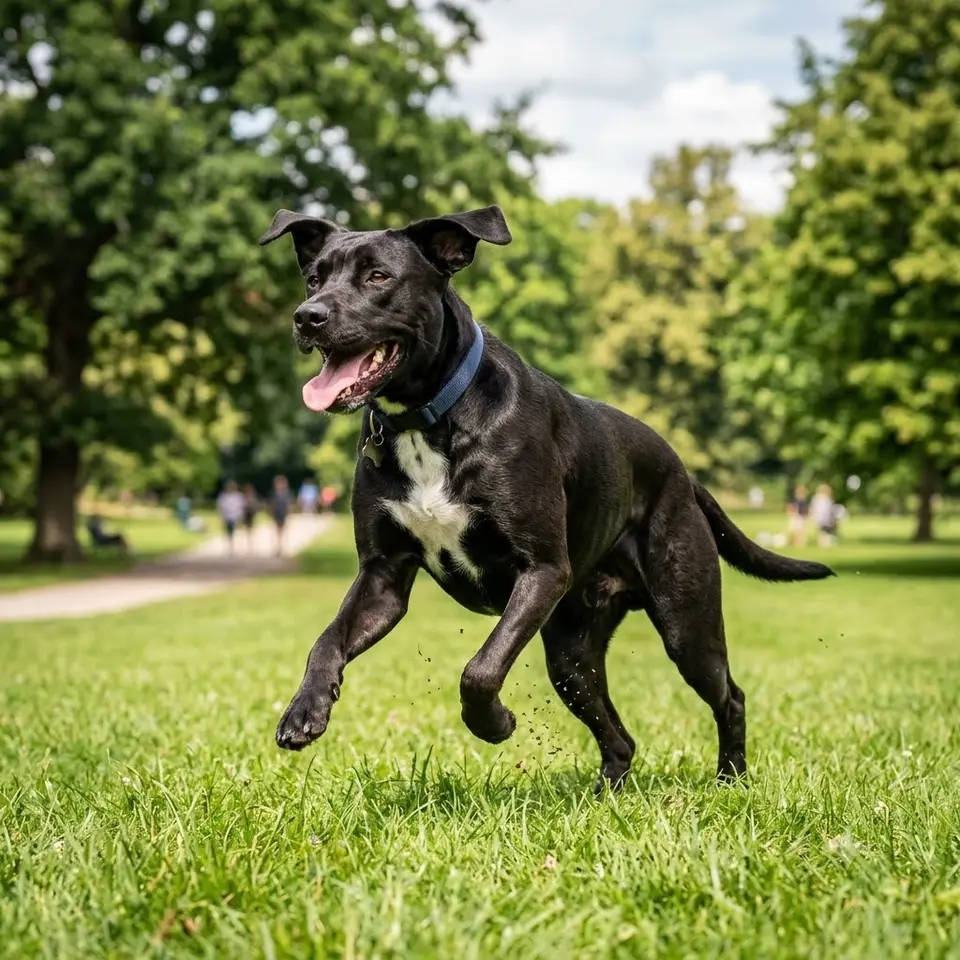 AI illustration
Overview
The Boxador is 30 kilos of galloping joy - Boxer clowning welded to Labrador friendliness in a strong, short-coated, perpetually delighted family athlete. It loves everyone with its whole body (often at speed), making training and space the two ingredients of success.
A designer cross: the Boxador is a Boxer × Labrador Retriever mix, not a standardised breed - individuals vary more than purebreds, in coat, size and temperament alike. No study has measured how long this cross lives; for the parent breeds the AKC lists 10-12 years (Boxer) and 11-13 years (Labrador Retriever).
History & Origins
A natural big-dog cross long common in shelters, adopted into the designer roster in the 2000s; another adopt-first mix.
The Boxer parent, the AKC says, was developed in Germany in the late 1800s, bred down from the larger Bullenbeisser, a hunting dog used to catch and hold bear, bison and boar. The Labrador began as the waterdog of Newfoundland and came to England in the early 1800s with visiting nobles.
Appearance
25-40 kg, deep-chested and muscular in black, brindle, fawn or brown, often white-flashed; short easy coat, expressive brow, tail always in motion. Typical size: Large, 25-40 kg. Coat: Short smooth - sheds moderately.
The Royal Kennel Club (UK) standard gives Boxer dogs a height of 57-63 cm and a weight of about 30-32 kg, bitches 53-59 cm and about 25-27 kg, with a short, glossy coat tight to the body; Labrador dogs should be 56-57 cm and bitches 55-56 cm, with a short, dense coat and a weather-resistant undercoat. The two parents are similar in height, and both coats are short.
Temperament & Character
Exuberant, affectionate, patient with kids, terrible at understanding its own size - a full-contact greeter until trained. Protective enough to alert, too friendly to guard.
Care
Serious daily exercise for the athletic frame; minimal grooming; bloat awareness (deep chest - no hard exercise around meals) and joint-friendly lean weight.
Health & Lifespan
The Boxador itself has no measured lifespan; the AKC figures for the parent breeds are in the overview.
Heart testing stands out on the Boxer side. The American Boxer Club's recommended tests, as the AKC lists them, include hip, elbow and thyroid evaluations, cardiac screening for aortic and subaortic stenosis, a DNA test for arrhythmogenic right ventricular cardiomyopathy (ARVC), an annual Holter monitor for Boxer cardiomyopathy and a DNA test for degenerative myelopathy; the AKC also names certain cancers and says the breed has little tolerance for extreme heat or cold. A Swedish study counted the Boxer among high-risk breeds for atopic dermatitis. The Labrador brings EIC, CNM and PRA-prcd DNA tests and the bloat risk of large, deep-chested dogs.
In 2013 UK records, both the Boxer and the Labrador were among breeds with reduced odds of anal sac disorders, and in a 2026 breathing study the Boxer had a significantly greater share of dogs free of BOAS signs than Pugs, French Bulldogs or Bulldogs. We describe these sources only; heart and other screening decisions belong with your vet.
Feeding & Nutrition
Measured large-breed meals; Lab appetite in a bigger chassis - portion discipline from puppyhood.
Pros & Cons
Pros
- Joyful, kid-loving temperament
- Low grooming
- Athletic adventure buddy
- Common as rescues
Cons
- Physically overwhelming untrained
- Needs real space and exercise
- Bloat risk management
- Boxer lines can shorten lifespan: ask
Best Suited For
- Active families with room
- Runners and hikers
- Experienced-ish big-dog homes
- Adopters browsing shelters
Sources
- AKC, Boxer: history, health and recommended tests: akc.org
- AKC, Labrador Retriever: history, health and recommended tests: akc.org
- Royal Kennel Club, Boxer breed standard: size, weight and coat: royalkennelclub.com
- Royal Kennel Club, Labrador Retriever breed standard: size and coat: royalkennelclub.com
- Nødtvedt et al., Veterinary Dermatology 2007: atopic dermatitis risk factors in Boxers, Bull Terriers and Westies: doi.org
- O'Neill et al., Veterinary Record 2021: anal sac disorders in UK dogs: doi.org
- Tomlinson et al., PLOS ONE 2026: BOAS in fourteen brachycephalic breeds: doi.org
Sources opened and checked on 16 October 2026.
Everyday gear for dogs
Links go to Amazon or a partner brand's own store and may earn us a commission at no extra cost to you. As an Amazon Associate we earn from qualifying purchases. An Amazon link leads to a type of gear and you choose the exact product; a card that names a store leads to that partner's own shop.
Boxador puppy growth chart
A typical growth curve for a large breed like the Boxador, estimated from its adult weight of 25-40 kg. Puppies vary with sex, genetics and diet, so treat this as a guide - for your own puppy, use the puppy weight predictor.
| Age | Typical weight | % of adult |
|---|---|---|
| 2 mo | 5.5-8.8 kg | 22% |
| 3 mo | 8.3-13.2 kg | 33% |
| 4 mo | 10.8-17.2 kg | 43% |
| 6 mo | 15-24 kg | 60% |
| 9 mo | 20-32 kg | 80% |
| 12 mo | 23-36.8 kg | 92% |
| Adult | 25-40 kg | 100% |
Boxador - frequently asked questions
Are they good with small children?
Temperamentally wonderful, physically like a friendly bowling ball - supervise and train greetings early; they knock toddlers over from pure love.
What's the bloat precaution?
Deep-chested dogs: feed calm measured meals, avoid vigorous exercise an hour around eating, and know the emergency signs (unproductive retching, swollen abdomen = vet NOW).
How long do they live?
No study has measured it. For the parent breeds the AKC lists 10-12 years (Boxer) and 11-13 years (Labrador Retriever) - ask about heart and cancer history on the Boxer side, which carries the breed's known risks.
Test yourself: guess the dog
Three clues from our quiz bank, each about another of our dogs. Can you name them?
Clue 1.Despite its glamorous lap-dog image, this small English breed retains a bold terrier temperament from its vermin-hunting origins.
It's the Yorkshire Terrier - read the full profile →
Clue 2.This powerful black-and-tan guardian was once used by Roman armies to drive and protect herds of cattle.
It's the Rottweiler - read the full profile →
Clue 3.A smart, eager-to-please herder with a fluffy medium coat, it craves a job and can develop bad habits if left bored.
It's the Australian Shepherd - read the full profile →
Adoptable dogs near you
Set on this breed? It is usually a designer cross, so here are dogs of every kind near you, live from Petfinder - filter by breed there if you like. We have no affiliation and earn nothing - if someone catches your eye, the link goes straight to their shelter. New to adopting? Start with our adoption guide.
Widget not loading (some ad-blockers hide it)? Search directly on petfinder.com.