Borador
The Borador pairs a Border Collie with a Labrador Retriever - yielding a quick, athletic, people-pleasing all-rounder that is one of the commonest and best farm-and-family mixes going.
Last reviewed: October 2026
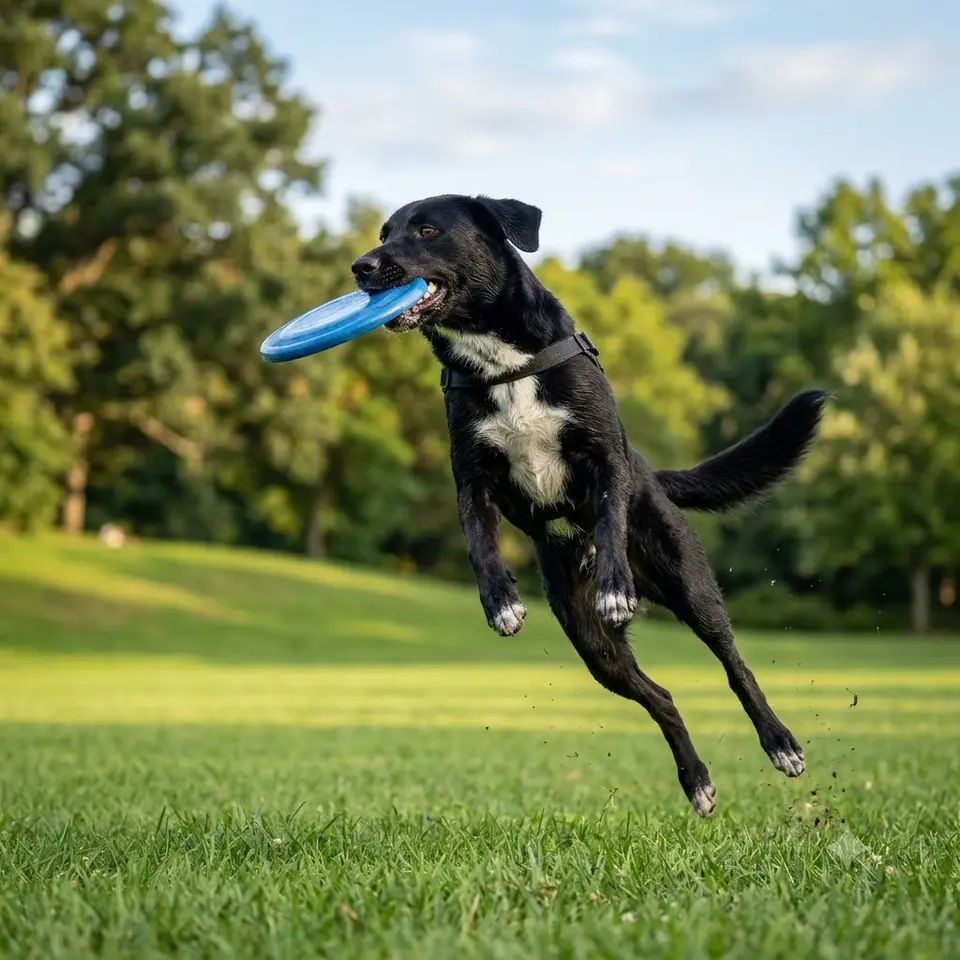 AI illustration
Overview
The Borador pairs a Border Collie with a Labrador Retriever - yielding a quick, athletic, people-pleasing all-rounder that is one of the commonest and best farm-and-family mixes going. Half genius, half goofball, wholly in need of things to do.
A designer cross: the Borador is a Border Collie × Labrador Retriever mix, not a standardised breed - individuals vary more than purebreds, in coat, size and temperament alike. No study has measured how long this cross lives; for the parent breeds the AKC lists 12-15 years (Border Collie) and 11-13 years (Labrador Retriever).
History & Origins
A longtime natural farm cross formalised by the designer era; shelters everywhere hold wonderful Boradors - adopt-first territory.
The Border Collie parent, in the AKC's account, descends from crosses of Roman herding dogs and the smaller spitz-type herders of Viking raiders, worked in the hills of Scotland and Wales, and has dominated sheepdog trials in the British Isles for more than a hundred years; it joined the AKC Herding Group in 1995. The Labrador began as the waterdog of Newfoundland and was refined by British breeders in the 19th century.
Appearance
15-25 kg, usually black (often with white chest/paws from the Collie), athletic and medium-coated; sheds moderately year-round. Typical size: Medium-large, 15-25 kg. Coat: Short-medium double coat - sheds.
In the Royal Kennel Club (UK) standards the Border Collie's ideal height is 53 cm for dogs, with bitches slightly less, and its coat comes in two varieties, moderately long or smooth, both with a soft, dense undercoat; Labrador dogs should be 56-57 cm and bitches 55-56 cm, with a short, dense coat. The AKC gives the Border Collie 30-55 pounds.
Temperament & Character
Clever, biddable, energetic and friendly - softer-edged than a pure Border Collie, sharper than a pure Lab. Some herding eye and gathering habits persist; strangers get wags.
Care
Daily exercise plus brainwork - fetch, training games, scent work; weekly brushing; standard robust-dog upkeep otherwise.
Health & Lifespan
The Borador has no lifespan data of its own; the overview gives the AKC figures for the parent breeds.
The AKC says Border Collie breeders screen for hip dysplasia, deafness, epilepsy, collie eye anomaly, neuronal ceroid lipofuscinosis and trapped neutrophil syndrome, with hip and eye evaluations on the club's list. The Labrador's list covers hips, elbows and eyes plus DNA tests for EIC, CNM and PRA-prcd. Washington State University's MDR1 laboratory gives an approximate frequency of 10% for herding breed crosses; the mutation can cause severe reactions to some common medications.
Two UK VetCompass findings favour both parents: the Border Collie and the Labrador were among six breeds with reduced odds of anal sac disorders in 2013 records, and the Border Collie had lower odds of otitis externa (odds ratio 0.34) in 2016 records. We found no study of the Borador itself. None of this replaces a vet's advice for your dog.
Feeding & Nutrition
Measured food for an athlete with a Lab appetite; lean matters for hips and joints.
Pros & Cons
Pros
- Bright AND friendly: rare combo
- More forgiving than pure Border Collies
- Superb active-family dog
- Common in shelters: adopt!
Cons
- Needs daily physical+mental work
- Sheds steadily
- May herd kids/bikes mildly
- Bored = mischief
Best Suited For
- Active families and singles
- First-time sporty owners
- Farms and big gardens
- Canine-sport beginners
Sources
- AKC, Border Collie: history, weight, health and recommended tests: akc.org
- AKC, Labrador Retriever: history and recommended tests: akc.org
- Royal Kennel Club, Border Collie breed standard: size and coat: royalkennelclub.com
- Royal Kennel Club, Labrador Retriever breed standard: size and coat: royalkennelclub.com
- Washington State University, MDR1 in dogs: breed frequencies: waddl.vetmed.wsu.edu
- O'Neill et al., Veterinary Record 2021: anal sac disorders in UK dogs: doi.org
- O'Neill et al., Canine Medicine and Genetics 2021: otitis externa in UK dogs: doi.org
Sources opened and checked on 16 October 2026.
Everyday gear for dogs
Links go to Amazon or a partner brand's own store and may earn us a commission at no extra cost to you. As an Amazon Associate we earn from qualifying purchases. An Amazon link leads to a type of gear and you choose the exact product; a card that names a store leads to that partner's own shop.
Borador puppy growth chart
A typical growth curve for a medium breed like the Borador, estimated from its adult weight of 15-25 kg. Puppies vary with sex, genetics and diet, so treat this as a guide - for your own puppy, use the puppy weight predictor.
| Age | Typical weight | % of adult |
|---|---|---|
| 2 mo | 4.1-6.8 kg | 27% |
| 3 mo | 6-10 kg | 40% |
| 4 mo | 7.5-12.5 kg | 50% |
| 6 mo | 10.2-17 kg | 68% |
| 9 mo | 12.8-21.3 kg | 85% |
| 12 mo | 14.6-24.3 kg | 97% |
| Adult | 15-25 kg | 100% |
Borador - frequently asked questions
Is a Borador easier than a Border Collie?
Considerably - the Lab half rounds off the intensity and adds sociability, while keeping impressive smarts. It's the Collie experience on training wheels.
How much exercise?
An hour-plus of real activity daily plus mental games; they match energetic households beautifully and wilt in sedentary ones.
Where do I find one?
Shelters and rescues constantly - collie-lab mixes are among the most common and most underrated dogs waiting for homes.
Test yourself: guess the dog
Three clues from our quiz bank, each about another of our dogs. Can you name them?
Clue 1.One of the heaviest dog breeds on Earth, this gentle giant can top 200 pounds and once guarded estates and fought in arenas.
It's the English Mastiff - read the full profile →
Clue 2.This small, long-coated herding dog looks like a miniature rough Collie and hails from rugged Scottish isles.
It's the Shetland Sheepdog - read the full profile →
Clue 3.This small, affectionate lapdog was recreated in the 1920s to look like the longer-nosed dogs in old royal portraits.
It's the Cavalier King Charles Spaniel - read the full profile →
Adoptable dogs near you
Set on this breed? It is usually a designer cross, so here are dogs of every kind near you, live from Petfinder - filter by breed there if you like. We have no affiliation and earn nothing - if someone catches your eye, the link goes straight to their shelter. New to adopting? Start with our adoption guide.
Widget not loading (some ad-blockers hide it)? Search directly on petfinder.com.