Why Do Cats Eat Grass?
Why cats eat grass: what two UC Davis surveys of cat owners found about how common it is, illness, vomiting, age and coat length, and which houseplants on the ASPCA list are toxic to cats. A reading guide, not veterinary advice.
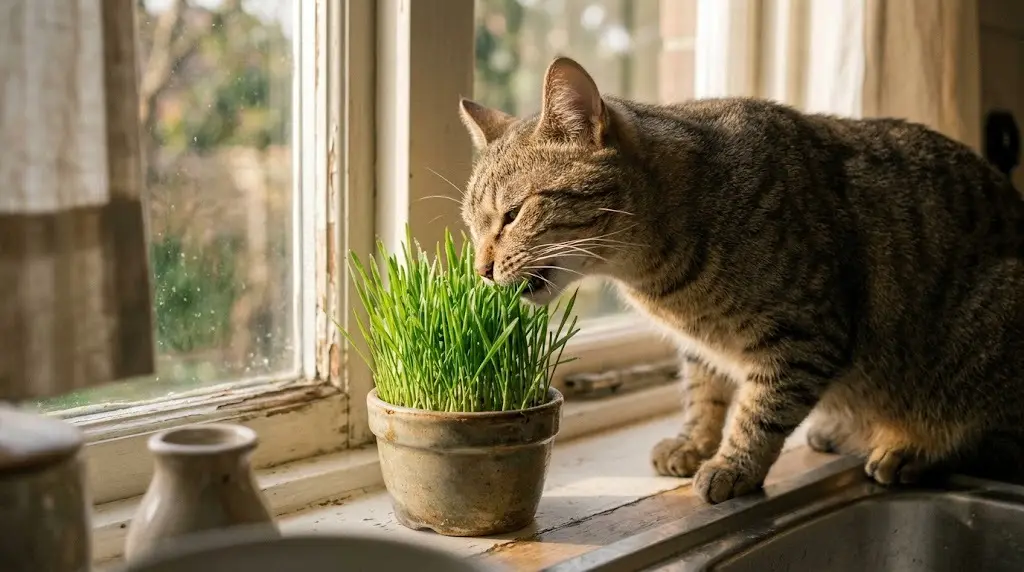 AI illustration
This is a reading guide to published research on plant eating in cats. Many houseplants are toxic to cats. If your cat has chewed a plant you are not sure of, call your vet or ASPCA Animal Poison Control on (888) 426-4435 (a fee may apply). A cat that vomits often, or seems unwell, needs a vet whatever it ate.
The short answer: nobody knows for certain, but it is normal. Most cats eat plants at some point, and the evidence does not back the two most popular explanations. Veterinary behaviorists at the University of California, Davis ran two large online surveys of cat owners, in 2006 and 2016. Very few cats seemed ill before eating plants, so it is not mainly a sick cat medicating itself. Long-haired cats ate plants no more often than short-haired ones, which argues against the hairball theory (Hart et al., 2021).
What the Surveys Found
From the UC Davis paper:
- It is common. In the 2016 survey, of roughly 2,000 cats, 65% ate plants every week.
- Cats rarely look sick first. Only 6% appeared ill before eating plants.
- Vomiting happens, but not every time. 27% of plant-eating cats in one survey and 37% in the other often vomited afterwards. The authors take this to mean a stomach upset may be involved in some cats.
- Young cats do it more. Younger cats ate plants more often than older ones, and appeared ill and vomited afterwards less often.
- Coat length makes no difference. Domestic short-haired and long-haired cats, and short-haired Siamese and long-haired Burmese, ate plants about as often.
So Why Do They Do It?
The authors point to an instinct inherited from wild cats, whose plant eating has been observed in the wild. One idea they discuss is that regular plant eating once helped wild cats purge intestinal parasites. They note that this could not be tested as a hypothesis in a survey. Their earlier work on dogs found the same pattern: plant eating is common, mostly not linked to illness, and more frequent in young animals.
The Real Risk: Toxic Plants
A cat that likes chewing greenery will not tell a safe grass from a toxic houseplant. The ASPCA keeps a list of plants toxic to cats. It includes several lilies, such as Asiatic lilies and daylilies, as well as aloe, amaryllis, English ivy and chrysanthemums. Check every plant in the house against it, and in the garden too if your cat goes out.
When to See the Vet
- Vomiting that is frequent, or happens without plant eating.
- Weight loss, poor appetite or lethargy.
- Any chewing of a plant on the ASPCA toxic list, or a plant you cannot identify.
Our guide to cat sneezing covers another common question. Cat grass and catnip are different plants; see why cats like catnip.