How to Brush Your Dog's Teeth
Brushing is the most effective home care for a dog's teeth. Which toothpaste to use and why human toothpaste is out, how to get a dog used to the brush in small steps, which surfaces to clean, and the signs that mean a vet visit.
 AI illustration
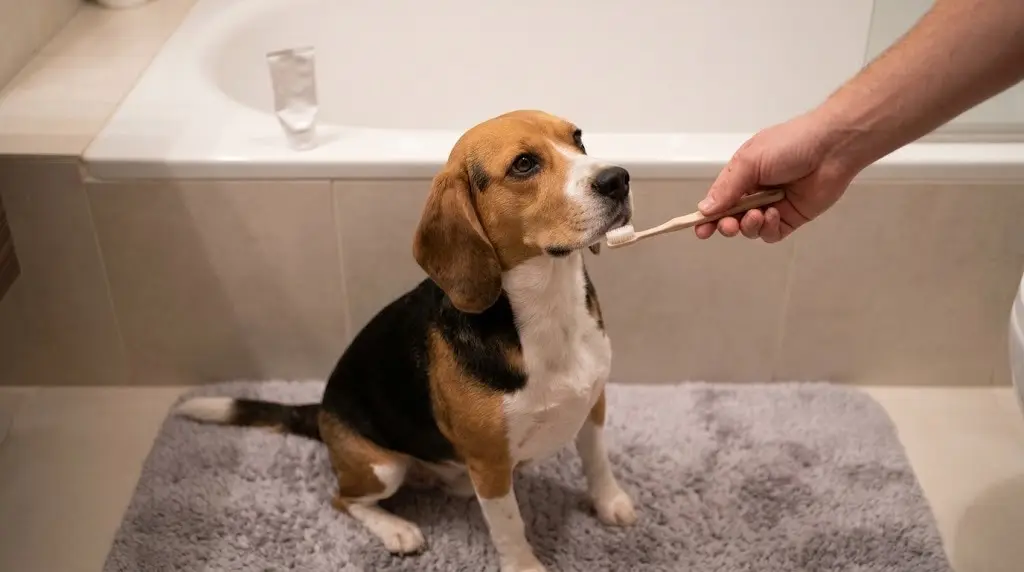
Brushing your dog’s teeth comes down to three things: a toothpaste made for dogs, a soft brush, and short, calm sessions that build up over a couple of weeks. The Veterinary Oral Health Council, which reviews dental products for pets, calls brushing the gold standard of home dental care, and a Texas A&M veterinarian says that ideally you should brush your pet’s teeth daily. Few dogs enjoy it on day one. With treats and patience, brushing can become a normal part of the evening routine.
Health note. This is a general home-care guide. It does not replace a dental check by your vet, and we do not give medical advice. If your dog’s mouth already looks sore, see the vet before you start brushing.
Why brushing is worth the effort
Plaque builds up on teeth every day. Left alone, it hardens into tartar and irritates the gums. Texas A&M’s article describes what gum disease means for pets: bad breath, painful irritated gums that can bleed, and loss of appetite. The VOHC puts the idea plainly: as long as the tooth surfaces are cleaned often, the gums stay healthy.
Brushing does not replace a vet’s dental exam. The same Texas A&M article says pets should also have their teeth cleaned and examined by a professional, and your vet will tell you how often your dog needs that.
Toothpaste and brush
Use a toothpaste made for pets. Dogs cannot spit or rinse, so whatever goes on the brush gets swallowed. That is why Texas A&M says to use toothpaste made for pets that is safe for them to swallow. Keep your own toothpaste for yourself. Many dog toothpastes are flavoured, and a flavour your dog likes makes the first weeks easier.
Pick a brush that fits the mouth. The usual options:
- A soft dog toothbrush with a long handle and a small, angled head. Many have a different-sized head at each end.
- A finger brush, a soft rubber sleeve with nubs that fits over your fingertip. At the start it lets you feel where the teeth are.
- Gauze wrapped around a finger, for the very first sessions with a nervous dog.
If you are unsure which toothpaste to buy, ask your vet, or look for the VOHC seal. The council reviews data from makers and awards its seal to products that show they reduce plaque, tartar or both. Our VOHC dental chew comparison explains how to read that seal.
Getting your dog used to it
Go slowly. Each step below can take a few days, and it is fine to stay on one step until your dog is relaxed with it.
- Choose a quiet time. After a walk, when your dog is tired and settled, works better than a lively moment.
- Let your dog taste the paste. Offer a little on your finger and praise. This turns the toothpaste into a treat.
- Touch the mouth. Gently lift the lip on one side and run a finger along the outer surface of a few teeth. Stop while your dog is still calm, and reward.
- Add the paste to your finger or gauze. Rub it along the front teeth and the big teeth at the side.
- Swap in the brush. Let your dog lick paste off the brush first, then brush a few teeth and stop.
- Build up. Add a few more teeth each session until you can do the whole mouth in one go.
Keep sessions short and end on a good note. If your dog pulls away, stop for the day and go back a step tomorrow.
How to brush
Once your dog accepts the brush:
- Lift the lip and hold the brush at an angle to where the tooth meets the gum.
- Brush in small circles along the gumline, working from the front teeth to the back.
- Focus on the outer surfaces. These are the ones you can reach easily, and most dogs will not let you open their mouth wide enough to do the inside.
- Do both sides, upper and lower, including the large back teeth where tartar tends to build.
- Finish with praise or a short game, so the next session starts on a good memory.
Brushing at the same time each day makes it easier for both of you to stick with it. It helps if your dog is already used to having its ears and paws handled, and our home grooming guide covers that kind of handling.
When to stop and see the vet
Stop brushing and book a vet visit if you notice:
- gums that bleed easily, look very red or swollen;
- a broken, loose or discoloured tooth;
- very bad breath that does not improve with brushing;
- your dog pawing at its mouth, dropping food, chewing on one side or eating less;
- any lump or sore inside the mouth.
A painful mouth will make brushing a bad experience for your dog, so get the problem treated first. The VOHC notes that many pets, especially middle-aged and older ones, need professional scaling on top of daily care, and our senior dog care checklist covers what to expect around dental work in older dogs. If something looks urgent, our guide on when to go to an emergency vet can help you decide.
If your dog will not accept a brush
Some dogs never get comfortable with it. In that case talk to your vet about other ways to slow plaque build-up, such as dental wipes, chews or water additives. The VOHC keeps a list of accepted products on its website, and it says the council does not test products itself; it reviews the data that makers submit. Even a dog that only lets you brush the front teeth is getting some benefit, so do what your dog allows and keep the vet checks.
Sources
- Texas A&M College of Veterinary Medicine & Biomedical Sciences, Pet Talk, “Dental care for your four-legged friend” (read 2 November 2026): vetmed.tamu.edu
- Veterinary Oral Health Council, home page (read 2 November 2026): vohc.org
Recommended Gear on Amazon
- Dog toothbrushes - browse current options and reviews on Amazon.
- Finger toothbrushes for dogs - browse current options and reviews on Amazon.
- Dog toothpaste - browse current options and reviews on Amazon.
As an Amazon Associate, we earn from qualifying purchases - at no extra cost to you. This helps us keep producing free, in-depth guides.