Dog Food for Liver Disease
What the Merck Veterinary Manual says about feeding a dog with liver disease - enough calories, small frequent meals, protein changes only for some complications, copper and sodium - and two prescription liver diets compared on what their makers publish. A reading guide, not veterinary advice.
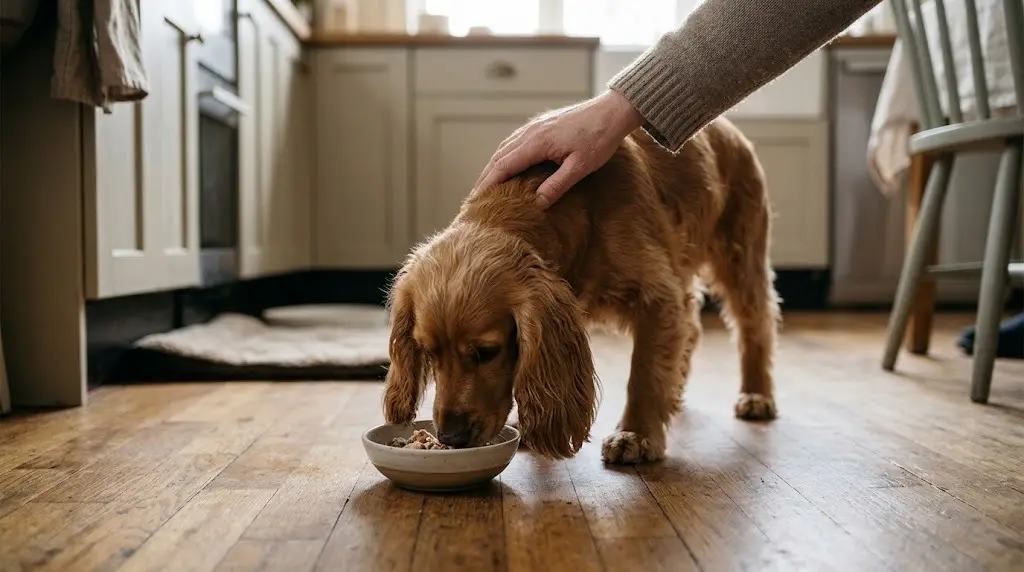 AI illustration
This is a reading guide to published veterinary information and to what makers state on their own pages. Liver disease has many causes, and the diet depends on which one your dog has. Your vet decides it. Do not add vitamins or supplements on your own: Merck warns that overdoses of some vitamins can be harmful.
The short answer: there is no single liver diet. What a dog with liver disease eats depends on the cause and the complications. The Merck Veterinary Manual gives the basics:
- Enough calories to keep a normal weight.
- Small, frequent meals may be best.
- Your vet’s specific advice, which Merck tells owners to follow.
A dog that refuses to eat may need tube feeding.
When the Diet Changes More
Merck describes several situations where food is part of the treatment:
- Hepatic encephalopathy, brain signs from toxins the failing liver no longer clears. A protein-modified, restricted diet may be prescribed once the dog is stable.
- Ascites, fluid in the belly. The first step is restricting sodium in the diet, often together with diuretics.
- Copper-associated liver disease, one of the most common causes of chronic hepatitis. Merck notes that adding zinc to the diet may help, because zinc can block the absorption of copper from the gut.
- Vitamins. Low potassium and B vitamins are common, and supplements are often recommended. Merck says vitamin C supplements are not recommended in dogs with copper storage liver disease. Your vet sets all of this.
Merck lists breeds with a higher rate of chronic hepatitis, including the Bedlington Terrier, Labrador Retriever, Cocker Spaniel, Doberman Pinscher, Standard Poodle, Springer Spaniel, Chihuahua, Maltese and West Highland White Terrier.
Two Prescription Liver Diets Compared
| Diet (dry) | What the maker states | Protein | Copper | Energy | Status on the label | Source |
|---|---|---|---|---|---|---|
| Hill’s Prescription Diet l/d, Chicken Flavor | ”Controlled levels of highly digestible protein”; “low copper to minimize accumulation in the liver” | Hill’s gives dry matter: 18.1% (fat 23.9%) | Low, as the maker states | 495 kcal per cup | Feeding tests: growing puppies and adult maintenance | Hill’s |
| Royal Canin Veterinary Diet Canine Hepatic | ”Adapted levels of high-quality proteins”; low copper | 14.0% min, as sold (moisture 10.5% max) | 7.2 mg/kg max | 323 kcal per cup | ”Intended for intermittent or supplemental feeding only” | Royal Canin |
How we put this together. The dry liver diets of two veterinary diet makers, compared on what each states on its own US product page, checked on 26 October 2026. One difference is easy to miss: Hill’s l/d carries an AAFCO statement for complete and balanced nutrition, while Royal Canin’s US page says its Hepatic dry diet is for intermittent or supplemental feeding only. Ask your vet what that means for your dog. Hill’s gives protein on a dry-matter basis and Royal Canin gives it as sold, so the numbers do not line up directly. Both are veterinary diets, so there are no shop links. We have not fed either.
What Liver Disease Looks Like
Signs vary, Merck says, and include loss of appetite, vomiting, diarrhea, seizures or other nerve signs, fever, bleeding problems, jaundice (a yellow tinge to the skin, gums and eyes), fluid in the belly, more thirst and urination, and weight loss. In acute liver failure, Merck advises telling your vet about every medicine your dog takes and any access it may have had to poisons.