Puggle
The Puggle crosses Pug clownery with Beagle nose-driven cheer - a sturdy, short-coated, hugely amiable little dog that laughs at life and follows its nostrils into mild trouble.
Last reviewed: October 2026
 AI illustration
Overview
The Puggle crosses Pug clownery with Beagle nose-driven cheer - a sturdy, short-coated, hugely amiable little dog that laughs at life and follows its nostrils into mild trouble. One of the healthier-breathing Pug alternatives when well-bred, it's an easygoing family comedian with a hound's appetite.
A designer cross: the Puggle is a Pug × Beagle mix, not a standardised breed - individuals vary more than purebreds, in coat, size and temperament alike. No study has measured how long this cross lives; for the parent breeds the AKC lists 13-15 years (Pug) and 10-15 years (Beagle).
History & Origins
One of the earliest famous US designer crosses (1980s-2000s boom), partly aimed at easing the Pug's breathing troubles with Beagle muzzle length.
Wikipedia's article, citing Woolf's 2007 book on designer dogs, says the Puggle began with accidental matings, that the first planned Pug and Beagle cross was made in Oklahoma in the 1990s, and that in 2006 Puggles made up more than half of all crossbreed dog sales in the United States; the Oxford English Dictionary records the name from 2002. PetMD places the cross's debut in the 1980s.
Appearance
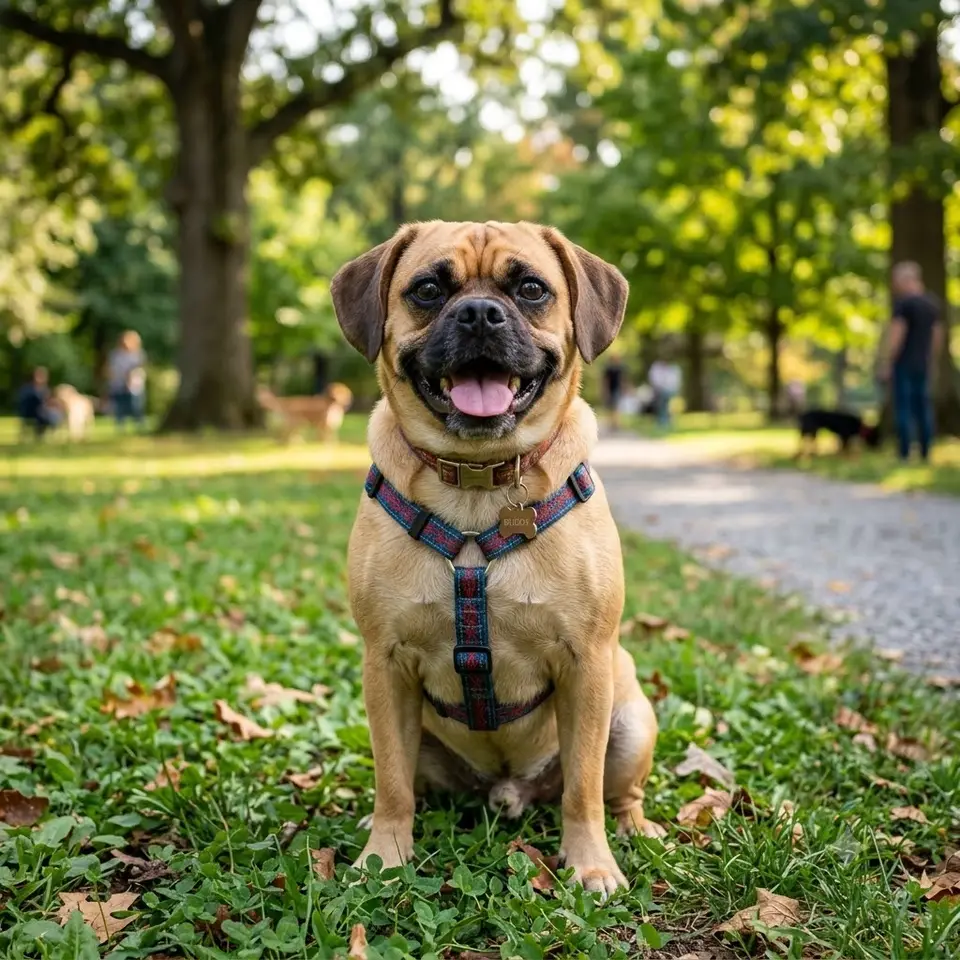
8-14 kg, fawn or black with a dark mask, wrinkled brow over a (usually) longer muzzle than a Pug, drop ears and a curl-adjacent tail. Short coat that does shed. Typical size: Small, 8-14 kg. Coat: Short smooth - sheds moderately.
The Royal Kennel Club (UK) standard gives the Pug an ideal weight of 6.3-8.1 kg and a fine, short, glossy coat; the Beagle should measure between 33 and 40 cm at the withers, with a short, dense, weatherproof coat. A 2026 UK study that measured Puggles found them less extreme in face shape than Pugs, with a relatively longer muzzle and less narrowed nostrils.
Temperament & Character
Merry, sociable, food-obsessed and pack-friendly - great with kids, dogs and visitors. Beagle nose means selective deafness outdoors; Pug side means professional-grade begging.
Care
Moderate exercise with heat caution (muzzles vary - some stay shortish); weekly brushing, wrinkle-fold cleaning if present, and serious food-security around the house.
Health & Lifespan
Lifespan has not been measured for the cross; the overview shows the parent breeds' AKC figures.
The Puggle is one of the few crosses studied directly. In the 2026 UK study, veterinary assessments of 48 Puggles, 51 Jugs (Jack Russell × Pug) and 51 Pugs found that purebred Pugs had a significantly higher prevalence of respiratory, eye, skin and musculoskeletal disorders than the crosses and higher veterinary costs, while behaviour and the owner relationship were similar. A 2022 VetCompass study found one exception: Puggles had high odds of cherry eye (prolapsed nictitating membrane gland, odds ratio 9.53 against crossbred dogs), although the Beagle showed no predisposition and the Pug was protected.
For the parents, the AKC lists hip and eye examinations, patellar luxation and a DNA test for Pug dog encephalitis as the Pug club's recommendations, and hip, cardiac, eye and thyroid evaluations plus a DNA test for Musladin-Lueke syndrome for the Beagle. Beagles also appear on Cornell University's list of breeds commonly affected by intervertebral disc disease. These are study results, not advice for your dog; your vet can say what applies.
Feeding & Nutrition
Strictly measured meals - Puggle obesity is the number-one owner failure; both parents are gifted beggars and it compounds.
Pros & Cons
Pros
- Sturdy, kid-proof cheerfulness
- Lower grooming than curly crosses
- Usually breathes better than a Pug
- Adaptable apartment-to-house
Cons
- Sheds (despite short coat)
- Food obsession = weight risk
- Nose overrides ears outdoors
- Some inherit shorter muzzles: check
Best Suited For
- Families with children
- Relaxed first-time owners
- Apartment-with-walks living
- People wanting low-groom charm
Sources
- Wikipedia, Puggle: history, citing Woolf, Hot Dogs (2007), The New York Times Magazine (2007) and the Oxford English Dictionary: en.wikipedia.org
- PetMD, Puggle: debut in the 1980s: petmd.com
- Royal Kennel Club, Pug breed standard: weight and coat: royalkennelclub.com
- Royal Kennel Club, Beagle breed standard: height and coat: royalkennelclub.com
- Youens et al., Animal Welfare 2026: health of Pugs, Jugs and Puggles: doi.org
- O'Neill et al., PLOS ONE 2022: prolapsed nictitating membrane gland (cherry eye) in UK dogs: doi.org
- AKC, Pug: health and recommended tests: akc.org
- AKC, Beagle: health and recommended tests: akc.org
- Cornell Riney Canine Health Center: intervertebral disc disease, commonly affected breeds: vet.cornell.edu
Sources opened and checked on 16 October 2026.
Everyday gear for dogs
Links go to Amazon or a partner brand's own store and may earn us a commission at no extra cost to you. As an Amazon Associate we earn from qualifying purchases. An Amazon link leads to a type of gear and you choose the exact product; a card that names a store leads to that partner's own shop.
Puggle puppy growth chart
A typical growth curve for a medium breed like the Puggle, estimated from its adult weight of 8-14 kg. Puppies vary with sex, genetics and diet, so treat this as a guide - for your own puppy, use the puppy weight predictor.
| Age | Typical weight | % of adult |
|---|---|---|
| 2 mo | 2.2-3.8 kg | 27% |
| 3 mo | 3.2-5.6 kg | 40% |
| 4 mo | 4-7 kg | 50% |
| 6 mo | 5.4-9.5 kg | 68% |
| 9 mo | 6.8-11.9 kg | 85% |
| 12 mo | 7.8-13.6 kg | 97% |
| Adult | 8-14 kg | 100% |
Puggle - frequently asked questions
Do Puggles have Pug breathing problems?
Usually milder (the Beagle muzzle helps), but check the individual pup's nostrils and ask the breeder about heat tolerance; muzzle length varies.
Why is my Puggle always hungry?
Genetics: Beagle scavenging plus Pug gluttony. Measured meals, no free-feeding, and childproof bins are the way of the Puggle household.
Can they be let off-lead?
In enclosed areas, yes; in open country the Beagle nose can drive away with the dog attached. Long lines are your friend.
Test yourself: guess the dog
Three clues from our quiz bank, each about another of our dogs. Can you name them?
Clue 1.This tiny toy terrier with a long, silky blue-and-tan coat was originally bred to catch rats in English textile mills.
It's the Yorkshire Terrier - read the full profile →
Clue 2.Bred to herd small livestock on windswept northern islands, this nimble dog is an eager, vocal worker.
It's the Shetland Sheepdog - read the full profile →
Clue 3.Developed along the hilly frontier between two British nations, this tireless sheepdog needs constant mental and physical work or it grows destructive.
It's the Border Collie - read the full profile →
Adoptable Puggles near you
Real dogs of this breed (and close mixes) waiting in shelters and rescues right now, live from Petfinder. We have no affiliation and earn nothing - if someone catches your eye, the link goes straight to their shelter. New to adopting? Start with our adoption guide.
Widget not loading (some ad-blockers hide it)? Search directly on petfinder.com.