Pomsky
The Pomsky is a cross of Pomeranian and Siberian Husky that looks like a miniature husky and became popular through social media.
Last reviewed: October 2026
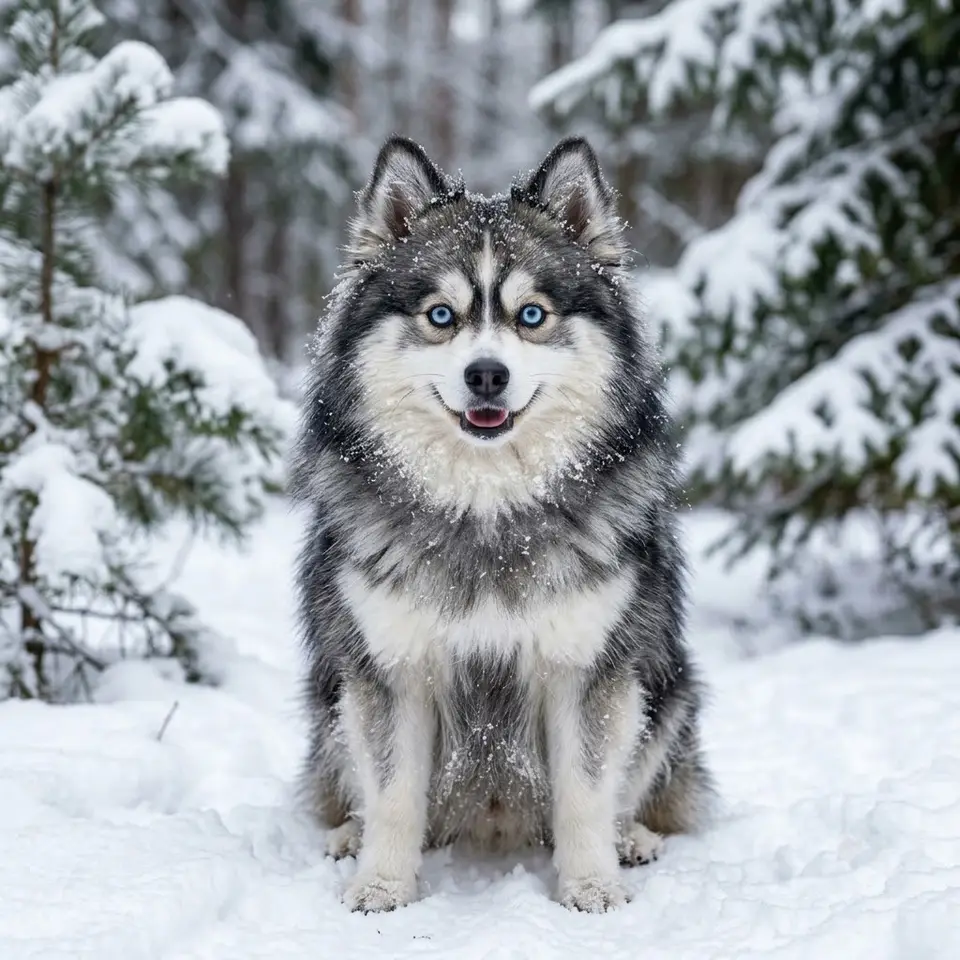 AI illustration
Overview
The Pomsky is a cross of Pomeranian and Siberian Husky that looks like a miniature husky and became popular through social media. The list of caveats is longer than usual: Pomskies shed enormously, talk loudly, and pack real husky energy and escape talent into a small charming frame. Gorgeous, yes; easy, no.
A designer cross: the Pomsky is a Pomeranian × Siberian Husky mix, not a standardised breed - individuals vary more than purebreds, in coat, size and temperament alike. No study has measured how long this cross lives; for the parent breeds the AKC lists 12-16 years (Pomeranian) and 12-14 years (Siberian Husky).
History & Origins
A 2010s social-media-era cross (via artificial insemination, Husky mother); demand ran ahead of breeding quality - vet breeders hard.
PetMD says Pomskies have only existed since 2012 and explains why first-generation litters come from artificial insemination: Pomeranians top out around 7 pounds and Huskies can reach 65, so the puppies are carried by a Siberian Husky mother and sired by a Pomeranian. The parents' histories are far apart. The AKC traces the Husky to the sled dogs of the Chukchi people of northeastern Asia, and the Pomeranian to larger spitz dogs bred down in Pomerania, with Queen Victoria credited for reducing it to toy size.
Appearance
7-17 kg and unpredictable within litters; the prize look is a mini Husky (masked face, blue eyes, plumed tail) in a thick DOUBLE coat that blows out twice a year in drifts. Typical size: Small-medium, 7-17 kg. Coat: Thick double coat - SHEDS heavily.
The size gap between the parents is large. The Royal Kennel Club (UK) standard gives the Pomeranian an ideal weight of 1.8-2 kg for dogs and 2-2.5 kg for bitches, against 20-27 kg for Siberian Husky dogs and 16-23 kg for bitches. Both have double coats: the Pomeranian a soft, fluffy undercoat under a long, harsh outer coat, the Husky a medium-length coat over a soft, dense undercoat.
Temperament & Character
Lively, clever, vocal (husky howls and pom opinions), affectionate with their family and famously mischievous. Escape-artist genes: fences, latches and boredom are all challenges.
Care
NOT low-shed: this is the anti-doodle, with daily brushing in season, fur everywhere, and real exercise plus mental work daily. Secure garden mandatory; they dig and climb.
Health & Lifespan
No study has followed Pomskies to measure their lifespan; the overview gives the AKC figures for the parent breeds.
Both parents have short AKC test lists. The Pomeranian club recommends patella, cardiac and eye evaluations, and the AKC names luxating patellas, hypothyroidism, collapsing trachea, congestive heart failure, seizures and alopecia X among the conditions breeders screen for. The Siberian Husky club recommends hip and eye evaluations and tests for two neurological conditions found in the breed, shaking puppy syndrome type 1 and polyneuropathy type 1; the AKC calls the Husky generally healthy and relatively long-lived, with a low incidence of hip dysplasia and eye disease.
PetMD's Pomsky page names patellar luxation, allergies and hip dysplasia as health issues of the cross. We found no veterinary study of Pomskies. This is a description of the sources, not advice; your vet is the person to ask about a particular dog.
Feeding & Nutrition
Quality measured food for a busy metabolism; watch weight in the smaller, poodle-free frame.
Pros & Cons
Pros
- Head-turning mini-husky looks
- Devoted, entertaining character
- More apartment-possible than a Husky
- Cold-weather superstar
Cons
- HEAVY shedding, twice-yearly blowouts
- Vocal: howls, 'talks', complains
- Escape artist and digger
- Wild quality variation between breeders
Best Suited For
- Experienced, active owners
- Cold climates
- People who love husky character at smaller scale
- Homes with secure yards
Sources
- PetMD, Pomsky: since 2012, artificial insemination, health issues: petmd.com
- AKC, Siberian Husky: history, health and recommended tests: akc.org
- AKC, Pomeranian: history, health and recommended tests: akc.org
- Royal Kennel Club, Pomeranian breed standard: weight and coat: royalkennelclub.com
- Royal Kennel Club, Siberian Husky breed standard: weight and coat: royalkennelclub.com
Sources opened and checked on 16 October 2026.
Everyday gear for dogs
Links go to Amazon or a partner brand's own store and may earn us a commission at no extra cost to you. As an Amazon Associate we earn from qualifying purchases. An Amazon link leads to a type of gear and you choose the exact product; a card that names a store leads to that partner's own shop.
Pomsky puppy growth chart
A typical growth curve for a medium breed like the Pomsky, estimated from its adult weight of 7-17 kg. Puppies vary with sex, genetics and diet, so treat this as a guide - for your own puppy, use the puppy weight predictor.
| Age | Typical weight | % of adult |
|---|---|---|
| 2 mo | 1.9-4.6 kg | 27% |
| 3 mo | 2.8-6.8 kg | 40% |
| 4 mo | 3.5-8.5 kg | 50% |
| 6 mo | 4.8-11.6 kg | 68% |
| 9 mo | 6-14.5 kg | 85% |
| 12 mo | 6.8-16.5 kg | 97% |
| Adult | 7-17 kg | 100% |
Pomsky - frequently asked questions
Do Pomskies shed?
Enormously - two double-coated parents mean serious year-round shedding with seasonal explosions. If low-shed matters, this is the wrong cross entirely.
Are they loud?
Often - husky howling and pom alert-barking both run in the family. Training and stimulation reduce it; silence isn't in the genes.
Why do sizes vary so much?
The parent size gap makes litters unpredictable - ask to see several generations and meet both parents; 'teacup pomsky' marketing is a red flag.
Test yourself: guess the dog
Three clues from our quiz bank, each about another of our dogs. Can you name them?
Clue 1.Bred in France to trail rabbits and hares at a slow walking pace, this short-legged dog has a heavy body, loose skin, and a mournful expression.
It's the Basset Hound - read the full profile →
Clue 2.Often seen in Renaissance portraits on noblewomen's laps, this dainty dog ranks among the smartest of the toy breeds.
It's the Papillon - read the full profile →
Clue 3.This small wrinkly-faced dog with a tightly curled tail and big round eyes was bred as a companion for Chinese emperors.
It's the Pug - read the full profile →
Adoptable Pomskys near you
Real dogs of this breed (and close mixes) waiting in shelters and rescues right now, live from Petfinder. We have no affiliation and earn nothing - if someone catches your eye, the link goes straight to their shelter. New to adopting? Start with our adoption guide.
Widget not loading (some ad-blockers hide it)? Search directly on petfinder.com.