Goldador
The Goldador merges dogdom's two great family retrievers into one - and the result is exactly what you'd hope: a supremely biddable, gentle, athletic family and service dog with double the retrieve drive and double the shed.
Last reviewed: October 2026
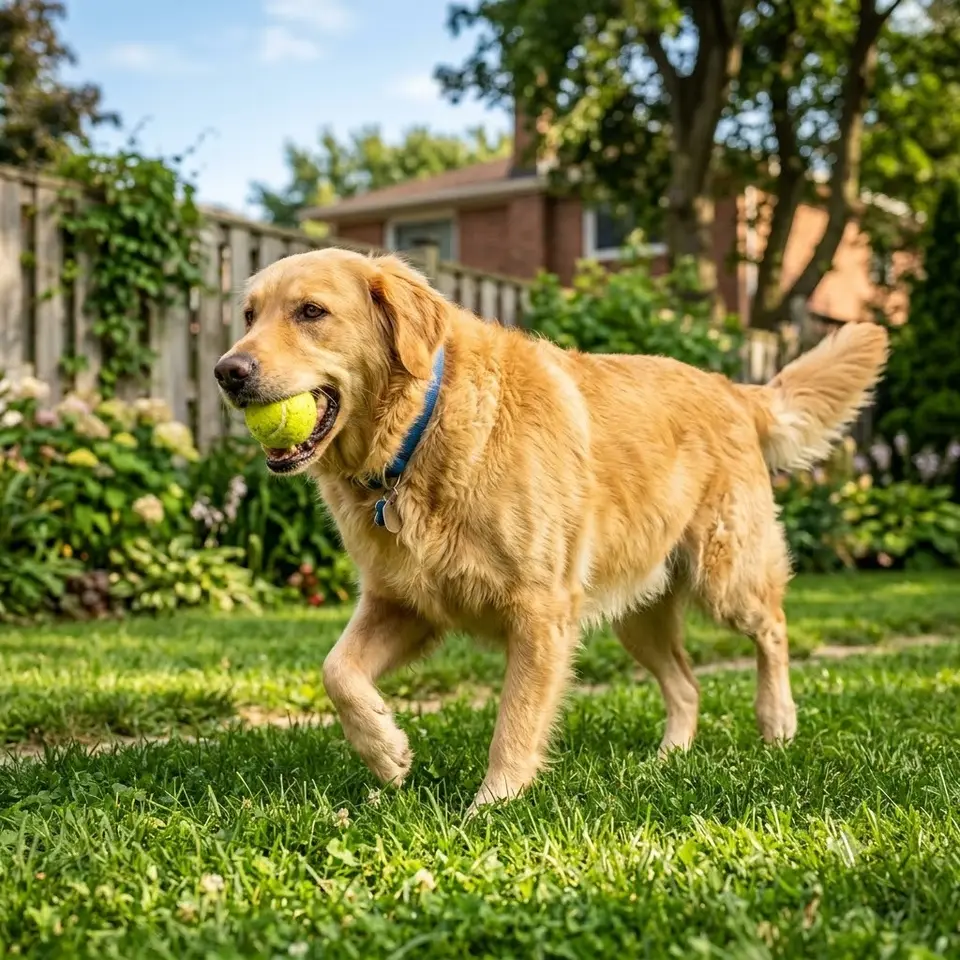 AI illustration
Overview
The Goldador merges dogdom's two great family retrievers into one - and the result is exactly what you'd hope: a supremely biddable, gentle, athletic family and service dog with double the retrieve drive and double the shed. Guide Dogs in the UK calls this cross its most successful guide dog of all.
A designer cross: the Goldador is a Golden Retriever × Labrador Retriever mix, not a standardised breed - individuals vary more than purebreds, in coat, size and temperament alike. No study has measured how long this cross lives; for the parent breeds the AKC lists 10-12 years (Golden Retriever) and 11-13 years (Labrador Retriever).
History & Origins
Long predates the doodle era: assistance and guide organisations have crossed Goldens and Labs since the late 20th century for temperament and trainability - the most 'proven' designer cross there is.
Guide Dogs, the UK charity, says over 60% of its working guide dogs are Labrador retriever cross golden retrievers, the most common type it places, and describes them as large, with kind eyes and floppy ears, in yellow, white or black. The cross also appears in veterinary research: a 2024 study of elbow CT screening before breeding used Labrador × Golden Retriever guide dogs.
Appearance
25-36 kg in gold-to-yellow shades (sometimes black from Lab lines), with a dense water-ready double coat and the classic soft-eyed retriever face. Typical size: Large, 25-36 kg. Coat: Dense double coat - SHEDS.
The parents are close in size. The Royal Kennel Club (UK) standard gives Labrador dogs an ideal 56-57 cm and bitches 55-56 cm, and Golden Retriever dogs 56-61 cm and bitches 51-56 cm. The Labrador coat is short and dense "without wave or feathering", the Golden's flat or wavy with good feathering, and both breeds have a dense undercoat that resists water and weather.
Temperament & Character
Gentle, patient, eager, universally friendly - a textbook family and service temperament with energy that needs daily outlets and a lifelong tennis-ball economy.
Care
Real exercise daily (they're working retrievers), weekly-to-daily brushing through heavy seasonal shedding, ear checks after swims - and they WILL swim.
Health & Lifespan
No study gives a lifespan for the Goldador itself; the parent breeds' AKC figures are in the overview.
The parents share their main screening: on the AKC pages, both clubs recommend hip and elbow evaluations and an eye examination. The Labrador list adds DNA tests for exercise-induced collapse (EIC), centronuclear myopathy (CNM) and PRA-prcd, and the AKC warns that Labs, like other large, deep-chested dogs, can develop bloat. The Golden list adds a cardiac exam, for conditions such as subvalvular aortic stenosis, and a DNA test for neuronal ceroid lipofuscinosis (NCL5); the AKC also names juvenile cataracts, pigmentary uveitis and progressive retinal atrophy.
UK primary-care data separate the two parents in places. In 2016 records the Golden Retriever had 2.23 times the odds of otitis externa of crossbred dogs, and in 2013 records the Labrador was among six breeds with reduced odds of anal sac disorders. We do not give veterinary advice; ask the breeder for the parents' scores and your vet about your own dog.
Feeding & Nutrition
Strictly measured - the appetite is legendary from both sides; obesity is this cross's main health enemy alongside hips.
Pros & Cons
Pros
- Gold-standard family temperament
- Supremely trainable
- Proven service-dog pedigree
- Great with kids and everything else
Cons
- Sheds substantially year-round
- Needs real daily exercise
- Gluttony requires policing
- Big-dog space and costs
Best Suited For
- Active families
- Service/assistance prospects
- First-time owners with energy
- Swimmers, hikers, fetch enthusiasts
Sources
- Guide Dogs (UK), crossbreeds: Labrador retriever cross golden retriever: guidedogs.org.uk
- Ellis et al., Veterinary and Comparative Orthopaedics and Traumatology 2024: elbow CT in Labrador × Golden Retriever guide dogs: doi.org
- Royal Kennel Club, Labrador Retriever breed standard: size and coat: royalkennelclub.com
- Royal Kennel Club, Golden Retriever breed standard: size and coat: royalkennelclub.com
- AKC, Labrador Retriever: health and recommended tests: akc.org
- AKC, Golden Retriever: health and recommended tests: akc.org
- O'Neill et al., Canine Medicine and Genetics 2021: otitis externa in UK dogs: doi.org
- O'Neill et al., Veterinary Record 2021: anal sac disorders in UK dogs: doi.org
Sources opened and checked on 16 October 2026.
Everyday gear for dogs
Links go to Amazon or a partner brand's own store and may earn us a commission at no extra cost to you. As an Amazon Associate we earn from qualifying purchases. An Amazon link leads to a type of gear and you choose the exact product; a card that names a store leads to that partner's own shop.
Goldador puppy growth chart
A typical growth curve for a large breed like the Goldador, estimated from its adult weight of 25-36 kg. Puppies vary with sex, genetics and diet, so treat this as a guide - for your own puppy, use the puppy weight predictor.
| Age | Typical weight | % of adult |
|---|---|---|
| 2 mo | 5.5-7.9 kg | 22% |
| 3 mo | 8.3-11.9 kg | 33% |
| 4 mo | 10.8-15.5 kg | 43% |
| 6 mo | 15-21.6 kg | 60% |
| 9 mo | 20-28.8 kg | 80% |
| 12 mo | 23-33.1 kg | 92% |
| Adult | 25-36 kg | 100% |
Goldador - frequently asked questions
Why choose a Goldador over either parent?
You're blending two proven family temperaments - many find the mix splits the difference: Golden softness with Lab bounce. Shelters also carry many retriever mixes just like it.
Do they shed less than a Golden?
No meaningful relief - double coat from both sides. If shedding is a dealbreaker, this isn't your cross (that's what doodles market).
Health checks?
Hips and elbows on both parents plus eye and heart clearances - standard large-retriever due diligence.
Test yourself: guess the dog
Three clues from our quiz bank, each about another of our dogs. Can you name them?
Clue 1.This versatile liver-spotted gundog freezes and aims its whole body at hidden game, even in water.
It's the German Shorthaired Pointer - read the full profile →
Clue 2.Known for striking merle coats and sometimes two different-colored eyes, this agile dog excels at frisbee, agility, and herding livestock.
It's the Australian Shepherd - read the full profile →
Clue 3.Bred down from a larger farm ratter, this wiry-coated companion has a stocky body and bold personality.
It's the Miniature Schnauzer - read the full profile →
Adoptable dogs near you
Set on this breed? It is usually a designer cross, so here are dogs of every kind near you, live from Petfinder - filter by breed there if you like. We have no affiliation and earn nothing - if someone catches your eye, the link goes straight to their shelter. New to adopting? Start with our adoption guide.
Widget not loading (some ad-blockers hide it)? Search directly on petfinder.com.