What A Dog Really Costs
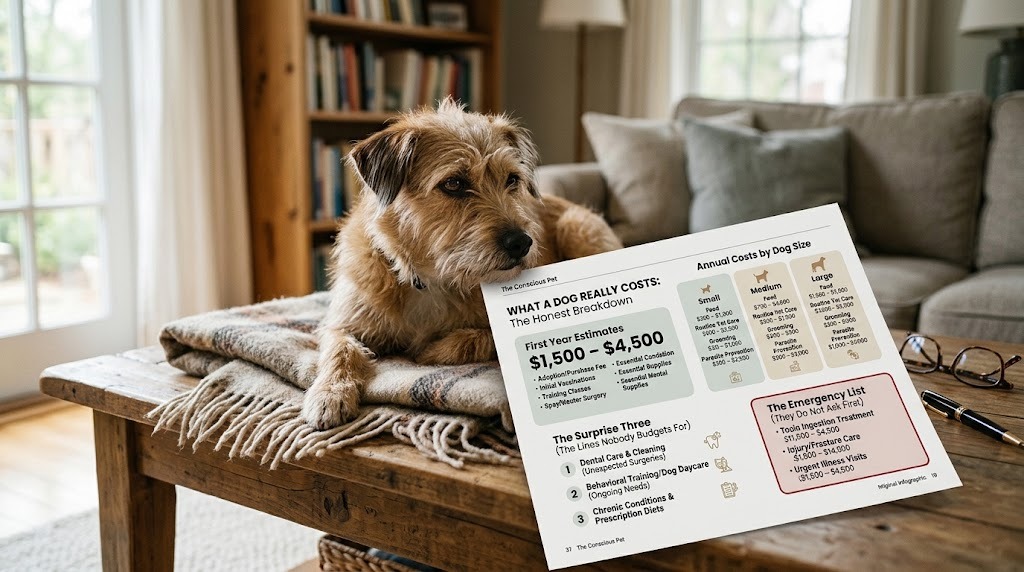
The first year of a dog typically runs $1,500 to $4,500 in the US, and most of the surprise sits in three lines nobody budgets for. Here is the honest breakdown - by dog size, by year, and by the emergencies that do not ask first.
What A Dog Really Costs
The short answer: in the US, a first year with a dog typically lands between $1,500 and $4,500, and after that most owners spend $1,000 to $2,500 a year - before anything goes wrong. The range is wide because dog size moves almost every line item, and because three costs people rarely budget for (veterinary emergencies, boarding, and dental work) are exactly the ones that hurt.
Prices below are typical US ranges as of 2026. Your city, your vet and your dog will move them - treat this as a planning skeleton, not a quote. For a number tuned to your situation, our first-year cost calculator does the arithmetic with your inputs.
The first year is the expensive one
The first year stacks one-time costs on top of the ordinary ones, and it is where most “I did not expect this” stories come from.
Getting the dog. Shelter adoption typically runs $50 to $400 and usually includes initial vaccines, a microchip and often the spay or neuter - which quietly makes it the best-value line in this entire article. A responsibly bred puppy commonly runs $800 to $3,000 depending on breed, and rare or fashionable breeds go far past that. Whatever the source, this is the one payment everyone plans for, and it is routinely under half of the first-year total.
Initial supplies. Crate, bed, leash and collar, bowls, brush, toys, gates. Done sensibly this is $150 to $400; done in a single delighted evening on a pet store website it is easily double. Buy the crate and one chew-proof bed first and let the rest prove it is needed. Our crate size calculator stops the most common oversized-crate mistake.
First-year veterinary care. Puppy vaccine series over several visits, parasite prevention, a spay or neuter if not included, and a wellness exam typically total $400 to $1,100. The puppy vaccination timeline shows how the visits space out, so the cost arrives in predictable steps rather than one bill.
Training. Group puppy classes run $100 to $300 for a course and are worth it for most first-time owners - not because the exercises are secret, but because a weekly deadline keeps humans practising. Private trainers run $50 to $150 an hour and are the right call for specific problems, not general education.
The ordinary years: what a dog costs when nothing goes wrong
- Food is the steadiest line and scales hard with size: roughly $250 to $500 a year for a small dog, $400 to $800 for a medium one, and $700 to $1,400 for a large or giant breed on a mid-range kibble. Fresh and prescription diets can triple those numbers. The dog food calculator converts your dog’s weight into daily portions and a real monthly cost.
- Routine veterinary care - annual exam, boosters, heartworm test - typically $200 to $500.
- Parasite prevention (flea, tick, heartworm) runs $150 to $400 a year depending on size and region.
- Grooming is near zero for a wash-and-go coat and $600 to $1,200 a year for coats that need professional work every six to eight weeks - poodles, doodles, shih tzus. This is a breed decision, made once, that bills you forever.
- Toys, chews, replacement gear: $100 to $300, honestly.
Two lines are optional on paper and rarely optional in practice:
- Insurance runs $250 to $900 a year for accident-and-illness cover depending on breed, age and region. Whether it is worth it is a real question with a real answer per household - we walk through the maths honestly in is pet insurance worth it. The alternative that actually works is a dedicated savings account fed monthly; the alternative that does not work is deciding at the emergency desk.
- Boarding or sitting: $30 to $85 a night in most markets. Two weeks of holiday a year is $400 to $1,200 - a travel cost that lives in the dog budget, not the holiday budget, because it exists whether or not you go anywhere nice.
The three surprises
Emergency vet visits. A swallowed sock, a torn cruciate ligament, a bad bloat night - four figures is normal, and $3,000 to $7,000 for surgery plus hospitalisation is not rare. Roughly one dog in three has some kind of unplanned vet visit in a given year. This is the single strongest argument for either insurance or a real emergency fund, and the worst possible time to discover you have neither.
Dental work. Professional cleaning under anaesthesia runs $300 to $1,000, more with extractions, and small breeds tend to need it repeatedly from middle age. Daily brushing is the cheap alternative that everyone is told about and few sustain - our dental chews guide covers what actually helps between cleanings.
The senior years. From about age seven for large breeds and ten for small ones, expect the veterinary line to drift upward: twice-yearly exams, bloodwork, joint support, and eventually medication that recurs monthly. Budgeting a senior dog at 1.5 to 2 times its middle-aged cost is realistic, and the joint-support side is covered honestly in our senior joint supplements guide.
Size is the biggest lever you control
Every recurring line - food, preventatives, boarding, most medications, many surgery bills - scales with kilograms. Over a 12-year life, the gap between a 6 kg terrier and a 45 kg mastiff is commonly $15,000 or more, before the mastiff’s shorter lifespan and higher orthopaedic risk enter the picture. None of this is an argument against big dogs. It is an argument for knowing the number before the puppy chooses you.
A realistic lifetime total, for a medium dog with ordinary luck: $18,000 to $35,000. Written down it looks enormous; spread over 4,500 days of a good dog it is a few dollars a day, and almost nobody who has done it calls it a bad deal. The point of the number is not to scare anyone off - it is that the dog pays the price when the budget was fantasy, because the corner that gets cut first is always veterinary care.
If you are still choosing a breed, our breed comparison tool puts grooming load, size and health tendencies side by side - which is most of this article’s cost variance, decided before day one.