Helping a Dog With Arthritis
How to spot arthritis early, the home changes that genuinely reduce joint pain - weight, flooring, ramps, warmth - and the decisions that belong to your vet.
Not veterinary advice. This is general information only - for anything medical, your vet is the right person to ask.
If your dog is stiff after rest, hesitates at stairs, or has stopped jumping onto the couch, arthritis is one common explanation, and only a vet can confirm it. Here is the honest division of labor: diagnosis and pain medication belong entirely to your vet, but the four levers with the biggest day-to-day impact are in your hands at home - weight, flooring, avoiding jumps, and warmth. This guide covers both halves and where the line between them sits.
Recognizing Arthritis Early
Dogs almost never cry from arthritis pain. They adapt, quietly, and the signs are changes in behavior rather than obvious limping:
- Stiffness after rest that “warms up” after a few minutes of walking - the classic early sign
- Hesitation before stairs, the car, or the couch; eventually refusal
- Bunny-hopping up stairs (both back legs together)
- Slowing on walks, turning back early, lagging behind
- Licking or chewing one joint repeatedly
- Muscle loss, especially visible in the hind legs and over the spine
- Behavior changes: irritability when touched near hips or shoulders, less greeting-at-the-door enthusiasm, sleeping more
- Weather sensitivity: visibly worse on cold, damp days
Any of these, persisting for more than a week or two, is worth a vet visit. Limping that appears suddenly, a limb the dog will not bear weight on, or crying in pain are same-week vet territory, not wait-and-see.
What You Can Genuinely Do at Home
1. Weight: the biggest lever by far
Nothing you can buy helps an arthritic dog as much as removing excess weight. Every extra pound loads the joints on every single step. In a trial of obese dogs with osteoarthritis, lameness eased noticeably once the dogs had lost about 6 to 9% of their body weight, with nothing else changed. Many owners underestimate their dog’s condition: you should be able to feel ribs easily under a thin layer, and see a waist from above.
If your dog is overweight, this is worth doing properly - measure meals with a scale or cup rather than pouring, cut the extras (treats add up faster than most owners expect), and aim for gradual loss over months. Your vet can set a target weight and a realistic plan; a portion calculator like the one in our tools section helps you sanity-check daily amounts.
2. Traction: fix the slippery floors
Hardwood, tile, and laminate are misery for arthritic dogs. Weak hindquarters plus slick flooring means constant micro-slips, each one a small jolt to sore joints - and one bad splay can cause real injury.
- Lay runner rugs or carpet tiles along your dog’s main routes: bed to door, bed to bowls, couch to yard.
- Keep nails properly short. Overgrown nails change foot mechanics and reduce grip. Trim the fur between paw pads too.
- For dogs that still slip, toe grips or traction socks can help; they take some getting used to.
This is the cheapest fix on the list.
3. Eliminate the jumps
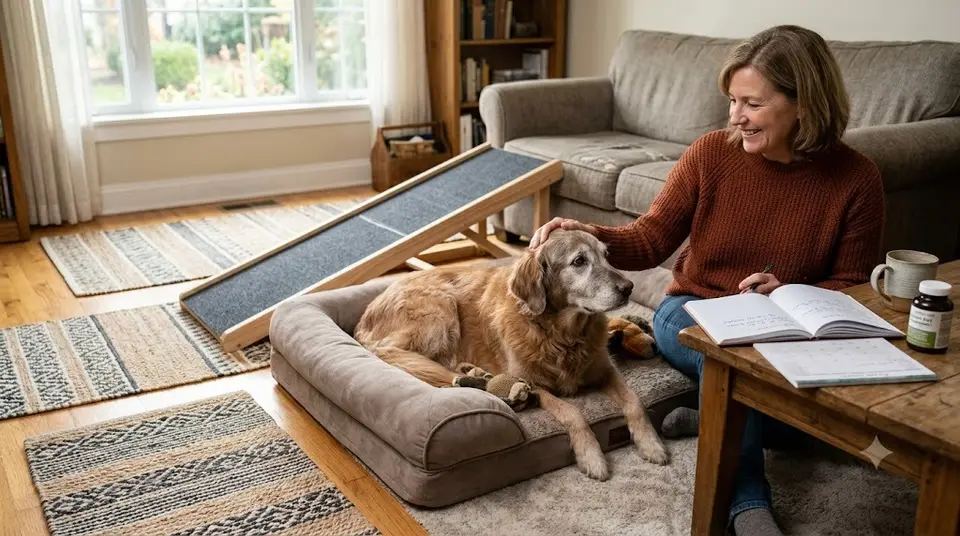
Jumping down loads the front legs on landing. A ramp for the car and steps (or a ramp) for the couch and bed remove dozens of hard impacts a day. Choose a car ramp with a weight rating comfortably above your dog and a surface with grip, and introduce it on flat ground with treats before asking the dog to use it at an incline. If lifting is your current solution, a support harness with a handle saves both your back and the dog’s dignity.
4. Warmth and a proper bed
Many arthritic dogs seem stiffer in the cold and on damp mornings.
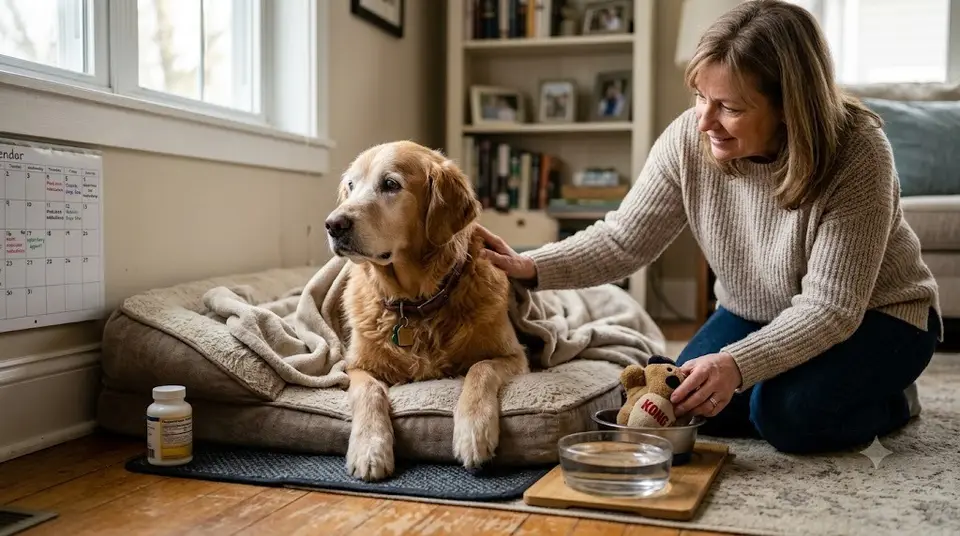
- An orthopedic bed with thick, supportive foam, big enough for the dog to lie flat on their side. Press a fist into it: if you feel the floor, it will not support a sore hip.
- Place beds away from drafts, doors, and cold tile.
- A heated pad designed for pets (with chew-safe cord and thermostat) under a blanket can help, especially overnight. Human heating pads on high settings are a burn risk for a dog who cannot easily move off them - if in doubt, ask your vet.
- A fitted dog coat for cold-weather walks is not vanity on a thin-coated arthritic senior; it is joint care.
5. Exercise: motion is lotion, in moderation
Rest sounds kind but backfires: muscle supports failing joints, and muscle disappears fast in a resting dog. The goal is consistent, moderate, low-impact motion.
- Short and frequent beats long and rare. Several short walks a day at the dog’s pace instead of one long outing; ask your vet how much suits your dog’s joints.
- Consistency over intensity. The same modest amount every day, including weekends. The “weekend warrior” pattern - couch all week, big hike Saturday - often ends in a limping Sunday.
- Surfaces matter. Grass and dirt trails are kinder than pavement.
- Swimming, where available and where the dog enjoys it, is real exercise with very little impact on the joints.
- Judge by the evening after. Dogs mask pain during the fun part. If your dog is notably stiff or flat the evening after a walk, that walk was too much.
Skip ball-chasing and hard fetch for arthritic dogs. The sprint-and-slam stop pattern is exactly the loading damaged joints handle worst - swap it for sniff-heavy walks or find-the-treat games, which tire dogs mentally at a fraction of the joint cost.
What Belongs to Your Vet
Some things are simply not home territory, and the honest thing is to say so plainly.
- Diagnosis. Stiffness has lookalikes - injuries, tick-borne disease, neurological problems, and others. Confirming that this is arthritis, and in which joints, is step one, and it may involve an exam and X-rays.
- Pain medication. There are prescription medicines approved for osteoarthritis pain in dogs. What to use, at what dose, with what monitoring - all vet decisions based on your dog’s bloodwork and history.
- Never give human painkillers. This deserves its own line. The FDA explains on its page about pain relievers for pets why ibuprofen, naproxen and other painkillers made for people may not be safe for a dog, and acetaminophen is no safer a guess. If your dog seems painful tonight, the safe move is calling a vet, not the medicine cabinet.
- Supplements. Joint supplements are a crowded, loosely regulated market with mixed evidence: omega-3 fish oil has the best support, glucosamine-chondroitin products much less - see our joint supplement guide. Rather than navigating that alone, ask your vet what, if anything, is worth adding for your dog - and treat any supplement as an addition to the measures above, never a substitute.
- Beyond pills. Vets may also discuss options like physiotherapy, hydrotherapy, laser therapy, or newer injectable treatments. Availability and evidence vary; your vet can tell you what is realistic locally and what is worth the money for your dog’s case.
A practical tip for the appointment itself: film your dog at home first. Thirty seconds of getting up from bed, walking, and climbing stairs shows your vet more than any description.
Tracking What Works
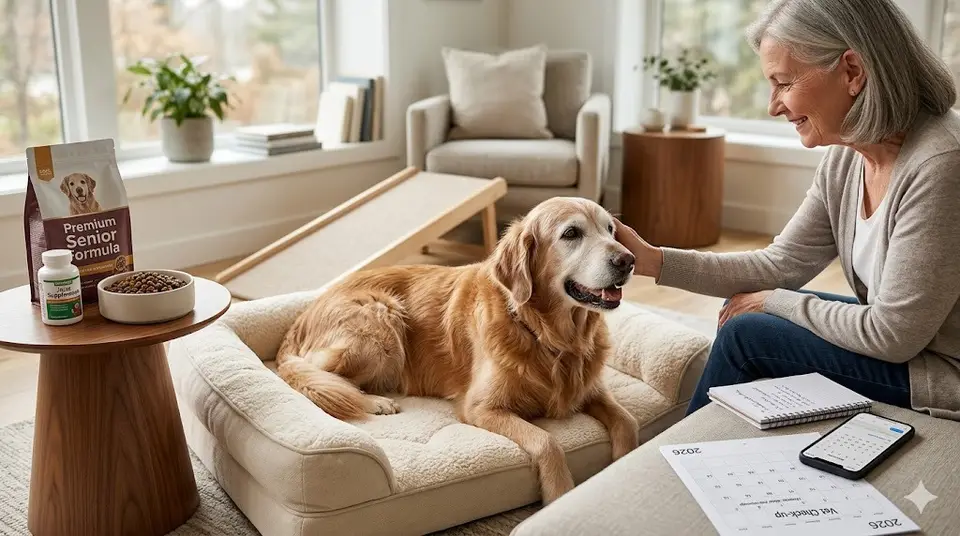
Arthritis is managed, not cured, and management improves when you measure. Keep a simple weekly note: how far the dog walks comfortably, stiffness on rising (none / mild / marked), stairs (yes / reluctant / no), and mood. When you change something - a new bed, a weight-loss month, a medication your vet prescribed - you will actually know within a few weeks whether it helped. If a specific problem is driving you crazy, from stair refusal to night restlessness, our problem solver breaks fixes down symptom by symptom, and our dog guides cover breed-specific joint tendencies.
The Short Version
- Early arthritis looks like stiffness after rest and quiet avoidance, not crying.
- Your four home levers: lean weight, rugs on slick floors, ramps instead of jumps, warmth and a real orthopedic bed.
- Exercise short, frequent, low-impact, and consistent - judged by the evening after.
- Diagnosis, medication, and supplements are vet decisions. Never give human painkillers.
An arthritic dog is not at the end of anything. A lean body, a grippy floor, a warm bed and a vet-managed pain plan give a dog the best chance of staying comfortable for a long time after the diagnosis.
Recommended Gear on Amazon
- Orthopedic dog bed - browse current options and reviews on Amazon.
- Pet ramp - browse current options and reviews on Amazon.
- Non-slip rugs - browse current options and reviews on Amazon.
As an Amazon Associate, we earn from qualifying purchases - at no extra cost to you. This helps us keep producing free, in-depth guides.