Senior Dog Care Made Simple
When your dog officially becomes a senior, what actually changes, and the home adjustments that matter most - beds, ramps, rugs, and a smarter vet schedule.
Not veterinary advice. This is general information only - for anything medical, your vet is the right person to ask.
A dog becomes a “senior” based on its expected lifespan, not a fixed birthday: the AAHA Senior Care Guidelines define senior as the last 25% of a dog’s estimated lifespan, which comes years earlier for a giant breed than for a small one. From that point, the two changes that help most are simple: adapt the house so moving around stays easy, and see the vet more often than once a year. Everything else in senior care builds on those two moves.
When Is Your Dog Actually a Senior?
Breeds differ widely in how long they live, and large breeds generally live shorter lives than small ones. Under the AAHA definition, “senior” is the last quarter of the expected lifespan, so the arithmetic is simple:
| Typical lifespan of the breed | Last quarter begins at about |
|---|---|
| 8 years | 6 years |
| 10 years | 7.5 years |
| 12 years | 9 years |
| 14 years | 10.5 years |
| 16 years | 12 years |
These are not switches that flip overnight. A fit 8-year-old Lab can act younger than a sedentary 6-year-old one. The label matters mostly because it should change how you watch your dog and how often a vet checks them, not because the dog suddenly needs a different life.
If you are unsure where your dog lands, breed pages like our dog breed guides list typical lifespans, and a lifespan or age calculator in our tools section can give you a rough equivalent age.
What Actually Changes With Age
Sleep
Senior dogs sleep more. Longer naps are normal. What is not normal: restlessness at night, pacing at 3 a.m., or a dog who suddenly cannot settle. Those patterns are worth a vet conversation, because they can point to pain or cognitive changes rather than “just age.”
Joints
Stiffness after rest is usually the first sign. Your dog takes a few slow steps after a nap, then “warms up.” Other early tells: hesitating at stairs, no longer jumping on the couch, and choosing shorter routes on walks. Arthritis is common in older dogs, and it is easy to miss because dogs rarely show pain openly.
Teeth
Dental disease is common in older dogs. Bad breath, yellow-brown buildup, dropping food, or chewing on one side are all signals. Untreated dental pain quietly reduces appetite and mood, and it is one of the most fixable problems on this list - but the fix (a cleaning under anesthesia, sometimes extractions) is a vet decision.
Weight
Weight can drift in either direction. Many seniors gain because activity drops while portions stay the same. Others lose weight, and unexplained loss is the more urgent signal - discuss it with your vet promptly rather than waiting for the annual visit. A good habit: weigh your dog monthly. Bathroom scale, hold the dog, subtract yourself. Write it down. A steady change in either direction is worth mentioning to your vet.
Senses and behavior
Hearing and vision fade gradually. A dog who “ignores” you may simply not hear you anymore. Cloudy eyes, bumping into moved furniture, startling when touched - note these and bring them up at the next checkup. Behavior changes like new clinginess, irritability, or confusion deserve the same treatment: note, then ask.
The Home Checklist
You do not need to remodel. The list below follows the home changes the AAHA guidelines suggest vets discuss with owners of older pets.
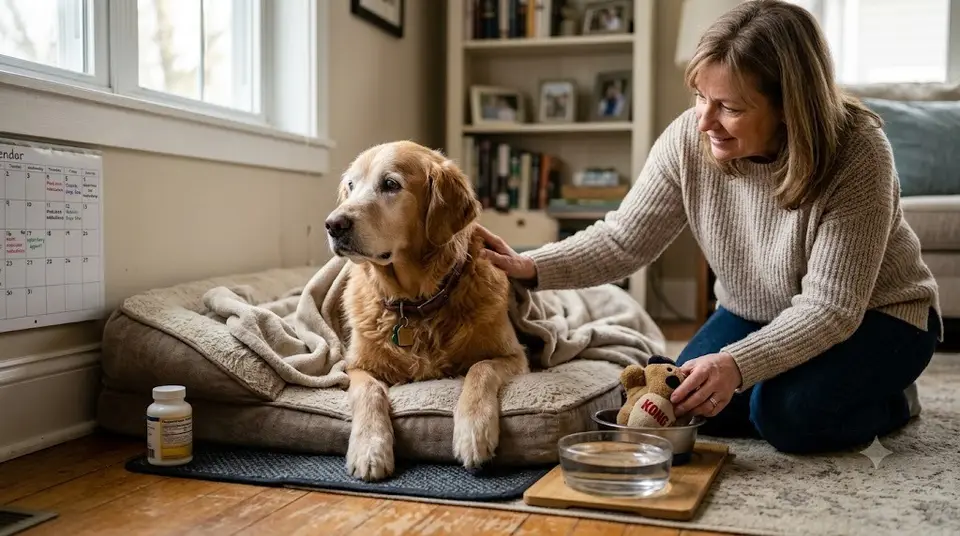
- Orthopedic bed. A real one: thick foam that does not bottom out when you press a fist into it. Thin polyfill beds compress flat exactly where an arthritic hip lands. Put one bed where the family spends evenings and one where the dog sleeps at night.
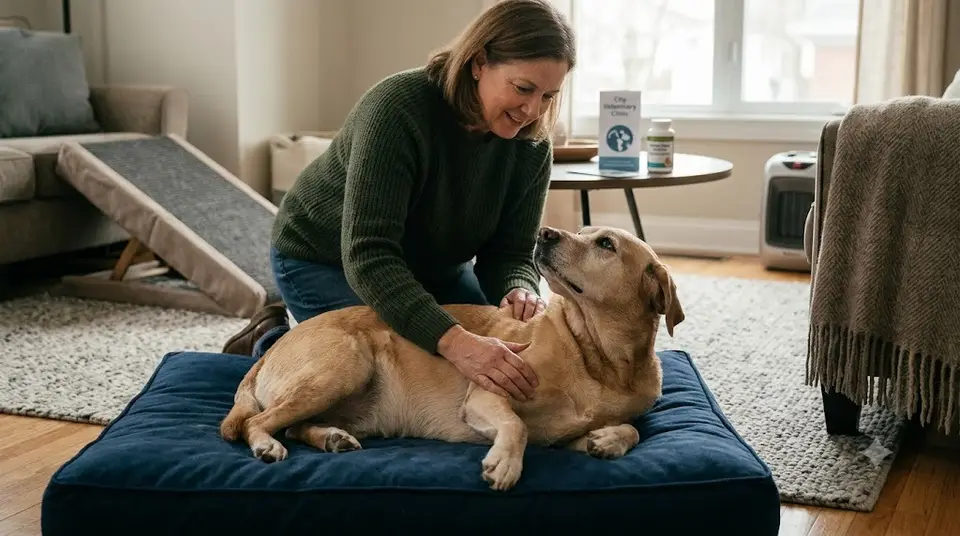
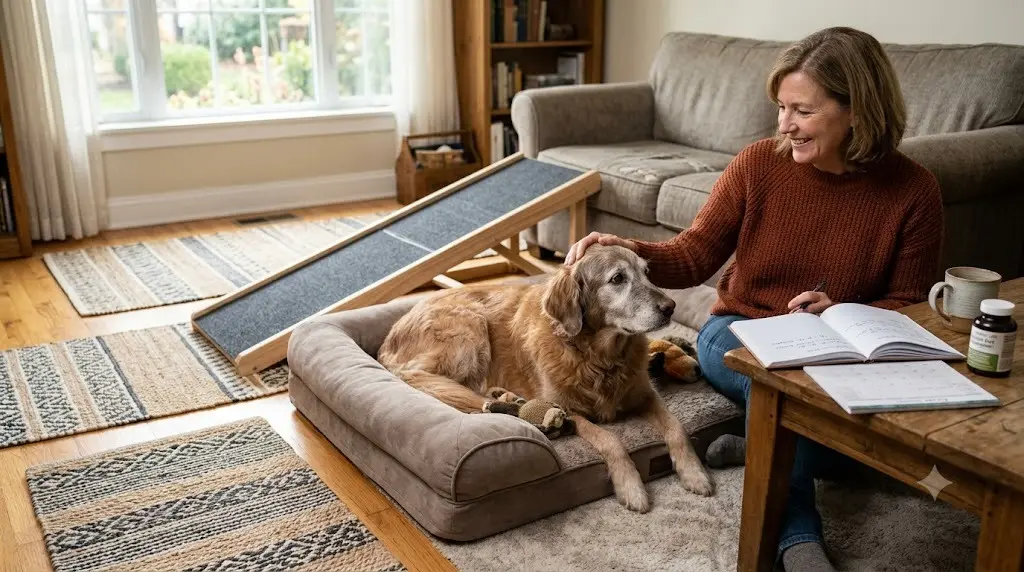
- Ramps or steps for furniture and cars. Every jump off a couch or out of an SUV hammers aging joints. A car ramp rated for your dog’s weight, and foam steps for the sofa or bed, remove a great many hard landings. Introduce them with treats before they are truly needed.
- Traction on slick floors. Hardwood and tile become genuinely risky for a dog with weaker hindquarters. Runner rugs along main routes - door to bed, bed to bowl - make an immediate, visible difference. Yoga mats work in low-visibility spots. Keep nails short and trim the fur between paw pads; both improve grip.
- Raised bowls - ask first. Raised bowls are on the AAHA list for stiff older pets, but a study of large and giant breed dogs linked them to a higher risk of bloat. For a big, deep-chested dog, ask your vet before raising the bowl.
- Night lights. A dim light along the route to water and the door helps dogs with fading vision navigate confidently after dark.
- Warmth. Move the bed away from drafts and off cold tile.
If your dog has already developed a specific issue - slipping, stair refusal, night pacing - our problem solver walks through fixes for individual symptoms.
Exercise: Shorter, More Often
Do not stop walking a senior dog - motion maintains the muscle that supports weak joints. The adjustment is structure: several short walks beat one long trek. Let sniffing set the pace. Swimming, where available, is low-impact exercise. Ask your vet how much suits your dog’s joints and heart. Skip weekend-warrior patterns: a sedentary week followed by a two-hour hike is exactly how seniors end up limping for three days.
Watch your dog the evening after exercise, not during it. Dogs push through pain in the moment; stiffness shows up hours later. If evenings look rough, shorten the outings and mention it to your vet.
Food and Water
A dog’s energy needs generally fall with age, the AAHA guidelines note, while older dogs tend to lose muscle - so the old habit of cutting protein for every senior is not what the guidelines advise for a healthy dog. Your vet can set the amount from body and muscle condition. “Senior” diet formulas vary widely in what they change, so read labels rather than trusting the word on the bag - and ask your vet what actually fits your dog, especially if kidneys, weight, or dental health are in play. Keep fresh water in more than one spot, so a stiff dog does not have to travel for it.
Vet Checkups: Twice a Year
The AAHA guidelines recommend a medical workup for senior pets once or twice a year. The diseases of old age - kidney disease, thyroid problems, heart disease, diabetes, dental disease - are easier to manage when caught early, which is the case for the second visit.
A senior workup typically includes a physical exam, a complete blood count, blood chemistry and a urine test - the AAHA table sets each of those at every 6 to 12 months. Baseline bloodwork while your dog is still healthy is genuinely useful: it gives your vet a normal to compare against later. Between visits, your job is observation. Keep short notes on your phone: appetite, water intake, stiffness, sleep, weight. Patterns you can report beat vague impressions, and they help your vet catch changes months earlier.
What Not to Worry About
Some changes are just aging: a graying muzzle, sleeping more, a calmer attitude toward other dogs, slightly cloudy-blue eyes in dim light (often lenticular sclerosis, an age change of the lens that is not the same thing as a cataract - your vet can tell the difference). Not every change is a disease. The skill of senior dog ownership is telling the difference between “slower” and “suffering,” and when you are not sure, that is precisely what the twice-yearly checkup is for.
The Short Version
- Senior means the last quarter of the expected lifespan - years earlier for a giant breed than for a small one.
- Watch sleep quality, joints, teeth, and monthly weight.
- Buy the orthopedic bed and the ramp before they are urgent, and put rugs on slick floors.
- Walk shorter and more often; judge by the evening after.
- See the vet once or twice a year, with bloodwork.
Old age is not an illness. With a prepared house and regular checkups, a dog can enjoy its senior years - slower, grayer, and every bit as good at being dogs.
Recommended Gear on Amazon
- Orthopedic dog bed - browse current options and reviews on Amazon.
- Pet ramp - browse current options and reviews on Amazon.
- Non-slip paw grips - browse current options and reviews on Amazon.
As an Amazon Associate, we earn from qualifying purchases - at no extra cost to you. This helps us keep producing free, in-depth guides.