Giant Asian Mantis
The Giant Asian Mantis is the big, bold, classic praying mantis - up to 9 cm of confident green predator that tracks your movements, takes prey from tweezers and embodies everything people imagine a pet mantis to be.
Last reviewed: July 2026
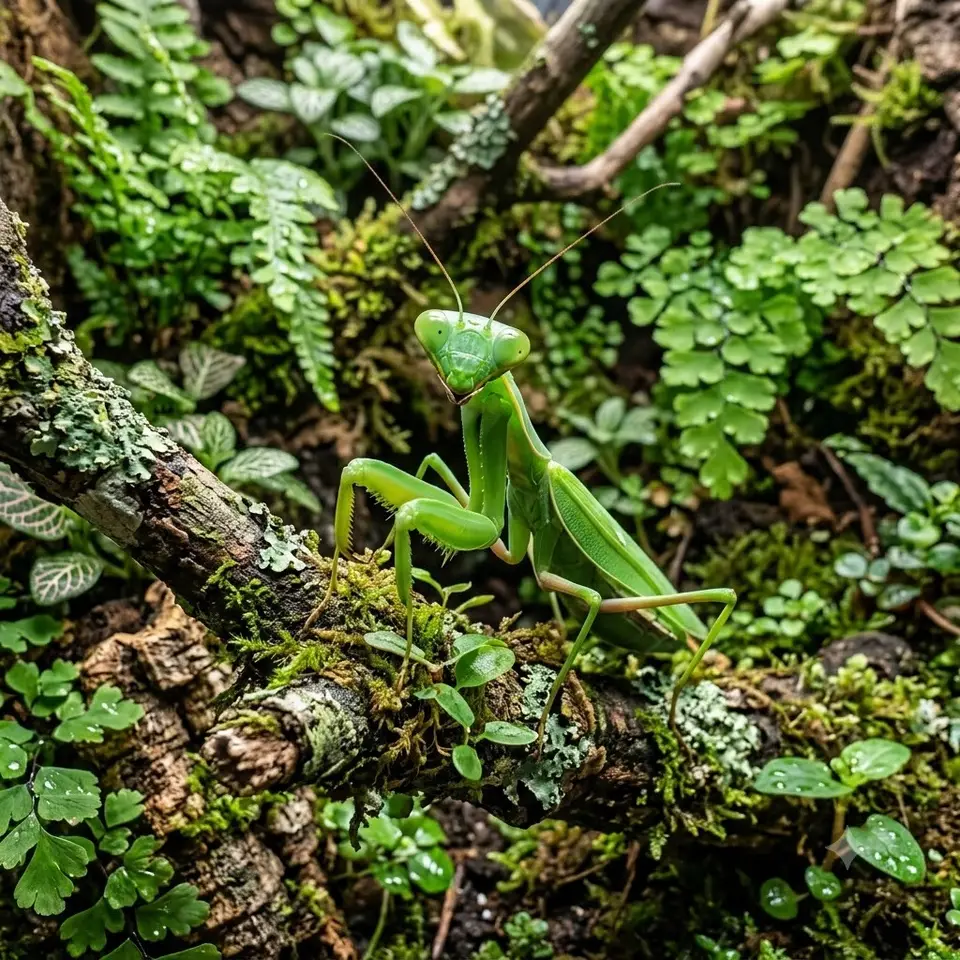 AI illustration
 Overview
The Giant Asian Mantis is the big, bold, classic praying mantis - up to 9 cm of confident green predator that tracks your movements, takes prey from tweezers and embodies everything people imagine a pet mantis to be. Average lifespan is 9-14 months. (Hierodula membranacea.)
Origin & Habitat
Forest edges and gardens across South and Southeast Asia, from India through Indonesia.
Appearance
7-9 cm; usually vivid leaf-green, sometimes tan or yellowish. A powerful build with broad raptorial arms - the archetypal mantis silhouette.
Temperament & Handling
Confident and food-driven - it will turn its head to follow you, reach for tweezered prey and stride around a hand. Adults can pinch with their arms; it's startling, not harmful.
Enclosure
Big mantis, big vertical space: 30 × 30 × 40 cm with sturdy branches and a mesh lid. Height is critical - a failed hang at the final molt is the classic tragedy of undersized cages.
Heating, Humidity, Lighting
24-30°C, 50-70% humidity, mist every other day. A forgiving, warm-room species that tolerates beginner conditions better than the ornate specialists.
Diet
An eating machine: crickets, roaches, flies and moths every 1-2 days, prey up to a third its own length. The tweezer-feeding response is immediate and spectacular.
Health & Lifespan
One of the hardiest mantids; give molt clearance and don't overfeed heavily gravid females. Females push past a year; males mature faster and live less.
Pros & Cons
Pros
- Large, imposing and interactive
- Eats anything, tames to tweezers
- Very forgiving starter mantis
Cons
- Under 15 months even at best
- Needs a taller cage than expected
- Adults may snatch at fingers near food
Everyday gear for exotic pets
Links go to Amazon or a partner brand's own store and may earn us a commission at no extra cost to you. As an Amazon Associate we earn from qualifying purchases. An Amazon link leads to a type of gear and you choose the exact product; a card that names a store leads to that partner's own shop.
Giant Asian Mantis - frequently asked questions
Is it a good first mantis?
The best all-rounder: big enough to be impressive, tough enough to forgive humidity wobbles, and eager enough to feed on anything that moves.
Why is my green mantis suddenly brown after a molt?
Color morphs shift with light, humidity and background between molts - both green and tan forms are healthy.
Can it fly?
Adult males fly readily (and escape readily at night); heavy females mostly flutter. Secure lids after the final molt.
Test yourself: guess the exotic pet
Three clues from our quiz bank, each about another of our exotic pets. Can you name them?
Clue 1.A slow-moving herbivore whose elongated body resembles a branch; it may sway gently to imitate a twig in the breeze.
It's the Stick Insect (Phasmid) - read the full profile →
Clue 2.This predatory insect, named for its folded, spiked forelegs held as if in prayer, is the only insect that can swivel its head nearly 180 degrees.
It's the Praying Mantis - read the full profile →
Clue 3.This hermaphrodite gastropod has both sexes in one body and can lay over a thousand eggs a year.
It's the Giant African Land Snail - read the full profile →