American Curl
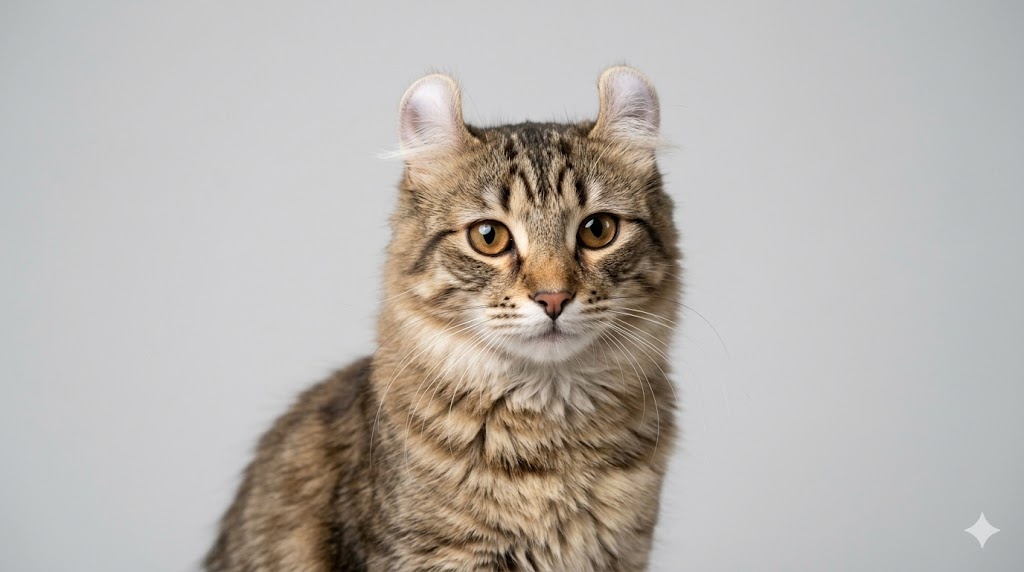
The American Curl is a medium-sized cat famous for its uniquely backward-curling ears.
🗓️ Last reviewed: September 2026
Overview
The American Curl is a medium-sized cat famous for its uniquely backward-curling ears. Unlike the Scottish Fold mutation, the American Curl gene affects only cartilage in the ears with no associated skeletal or systemic disease - making the breed a welfare-friendly alternative for owners who want unusual ears.
History & Origins
In 1981 a stray longhaired black cat with curled-back ears appeared at the home of Joe and Grace Ruga in Lakewood, California. The cat - Shulamith - became the foundation of the breed. Her kittens were curl-eared too, identifying a dominant gene. CFA recognition came in 1993.
Kittens are born with straight ears; the curl develops over 3-7 days, then settles into a permanent shape by 4 months.
Appearance
Medium-sized, balanced. Adults weigh 3-5 kg (7-11 lb).
- Coat: two varieties - shorthair (silky, close) and longhair (silky, semi-long with feathered tail).
- Colour: all colours and patterns.
- Ears: curled backward 90-180 degrees in a smooth arc. The cartilage feels firm but flexible.
- Eyes: walnut-shaped, expressive.
- Body: semi-foreign - moderate, balanced.
Temperament & Character
Friendly, playful, intelligent. The breed bonds strongly with family, is excellent with children, and remains kitten-like into old age. Many Curls are described as "Peter Pan cats" for their lasting playfulness.
Care
Coat & Grooming
Shorthair: weekly brushing. Longhair: 2-3 times weekly.
Clean ears weekly - the curl traps wax and debris. Gentle handling - the cartilage is firm but can be damaged by rough manipulation.
Trim claws every 2 weeks. Brush teeth several times weekly.
Health & Lifespan
12-16 years.
- Hypertrophic cardiomyopathy (uncommon).
- Ear infections - curled shape can trap debris.
The breed is generally healthy. No major breed-specific genetic diseases - unlike the Scottish Fold mutation, the American Curl gene affects only ear cartilage.
Pros & Cons
Pros: unique appearance, healthy, family-friendly, long-lasting playfulness. Cons: ears need regular cleaning; cartilage can be damaged by rough handling.
🐾 Everyday gear for cats
Links go to Amazon or a partner brand's own store and may earn us a commission at no extra cost to you. As an Amazon Associate we earn from qualifying purchases. We link gear types, not sponsors' picks: you choose the exact product.
American Curl - frequently asked questions
American Curl vs Scottish Fold - which is healthier?
American Curl. The Curl gene affects only ear cartilage; the Fold gene causes systemic skeletal disease. American Curl is the welfare-friendly choice.
Why do their ears curl?
A dominant genetic mutation affects the cartilage in the ear. Kittens are born straight-eared; the curl develops in the first week.
Are they good with kids?
Excellent.
Are they hypoallergenic?
No.
🧠 Test yourself: guess the cat
Three clues from our quiz bank, each about another of our cats. Can you name them?
Clue 1.This affectionate cat is a deliberate hybrid of two Asian-derived breeds, producing a medium 'mink' coat with aqua-colored eyes.
It's the Tonkinese - read the full profile →
Clue 2.Legend says this color-pointed cat earned its pure white paws, like gloves, as a blessing from a temple goddess in old Burma.
It's the Birman - read the full profile →
Clue 3.This sleek, fine-boned cat is essentially a same-shaped relative of the Siamese but in hundreds of colors.
It's the Oriental Shorthair - read the full profile →
💛 Adoptable American Curls near you
Real cats of this breed (and close mixes) waiting in shelters and rescues right now, live from Petfinder. We have no affiliation and earn nothing - if someone catches your eye, the link goes straight to their shelter. New to adopting? Start with our adoption guide.
Widget not loading (some ad-blockers hide it)? Search directly on petfinder.com.