Ways to Remember Your Pet
Gentle, concrete memorial ideas: garden stones and planted trees, paw prints, photo books, shelter donations - and an honest word on when a next pet makes sense.
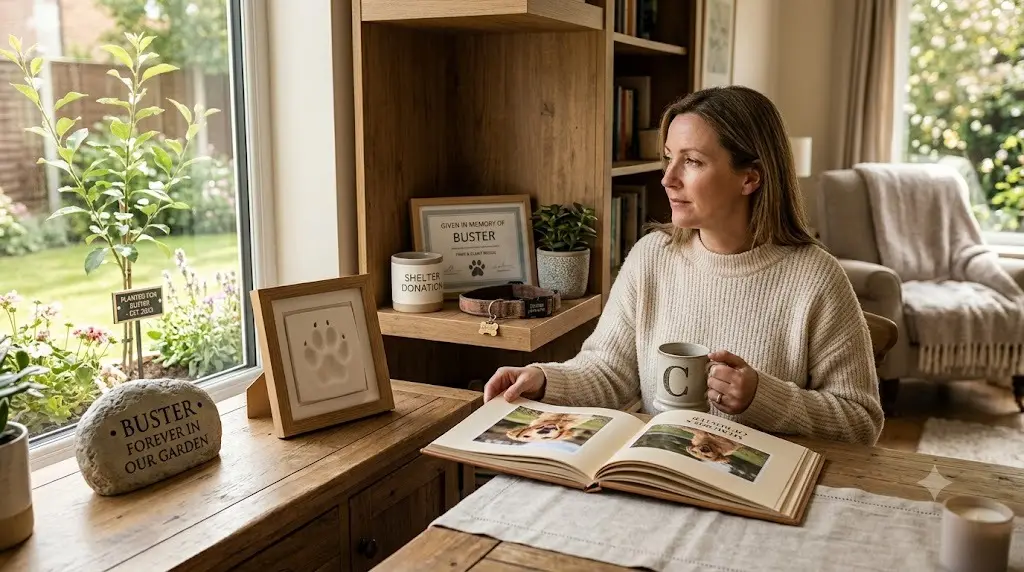
The best pet memorial is the one you will actually visit - in the yard, on a shelf, in a book you can open. There is no correct format, no minimum budget, and no deadline: some people create something within days because their hands need a task, others wait a year, and both are right. What follows is a practical menu, from free to significant, organized by the kind of comfort each one offers. Take one idea or none; the remembering matters more than the object.
In the Garden: Living Memorials
Living memorials suit people who want somewhere to go - a place where remembering has a location and the memorial itself grows.
- A memorial tree or shrub. Plant something with presence and longevity: a small ornamental tree, a rose, a lilac. If your pet’s ashes will be part of it, a practical honesty: cremation ashes in quantity can raise soil pH and are not automatically good for plants, so mix them widely through the planting soil rather than pouring them into one concentrated spot, or use one of the purpose-made mixes designed to buffer ashes for planting.
- A favorite-spot marker. If your pet had a sunbathing corner or a patrol post, mark it: a rough stone, a small border, a solar lantern. Marking where they lived can feel truer than marking where they are buried.
- A memorial garden stone. Options range from engraved granite to hand-painted river rocks that cost nothing. Weatherproof paint pens and a clear sealant make a homemade stone last years: and a stone painted by children carries a weight no engraving matches.
- Container version for renters: a large planted pot with a small marker travels with you between homes, and the plant can eventually go into the ground of a permanent garden.
If you buried your pet at home, check local rules first - home burial is regulated in some places, with requirements about depth and distance from water, and your local authority has the rule that applies to you. It is unglamorous information, but knowing it prevents painful surprises.
Keepsakes: Something to Hold
- Paw prints. If they were not taken at the vet (many clinics offer an ink or clay print: worth asking even after the fact, as crematories sometimes can), you have options with the things left behind: a print pressed in an air-dry clay kit, or a jeweler can work from a clear ink print. If your pet is still with you and you are reading this ahead of need, take the print now: a calm afternoon paw print is easier on everyone.
- Nose prints make a distinctive small keepsake using the same ink-and-paper method.
- Fur and whiskers. A small clipping of fur in a locket or keepsake jar, or naturally shed whiskers, cost nothing and feel surprisingly significant. Whiskers found around the house in the weeks after are little gifts; keep a small box for them.
- The collar and tag. The most personal object your pet owned. On a hook by a photo, around the neck of a memorial candle, in a shadow box, or (a quietly popular choice) clipped to your everyday bag or keys for a while. Wearing the tag as a keychain is free and travels everywhere.
- Ashes jewelry and glasswork. A small portion of ashes can be incorporated into glass beads, pendants, or rings. Quality and prices vary widely; read recent reviews carefully, and only send a small portion of ashes, never the entirety, in case anything goes wrong in transit.
- A shadow box. Collar, tag, a favorite toy, one great photo, maybe the paw print: assembled behind glass. This one works well as a family project, and assembling it is itself a form of goodbye.
Paper and Pixels: The Story Kept
- The photo book. Possibly the highest-value memorial for what it costs. Two honest tips: include the ordinary photos, not just the flattering ones: the blurry mid-zoom shot and the sleeping-in-a-weird-position shot are where the personality lives; and let everyone in the household pick a few pages. Do it while the phone photos are still organized in your mind.
- A written portrait. One page: their habits, their sounds, the specific things nobody else would know: the exact spot they waited at 5 p.m., their opinion about the vacuum. Written memories outlast photographic ones in specificity, and a year from now you will be glad you recorded the details that are vivid today.
- Children’s contributions. Drawings, a dictated story, a list titled “the best things about Max.” For a child, making something is processing something: and their contributions belong in the photo book too.
- A video compilation. Even 90 seconds of clips with their sounds (the bark, the purr, the tags jingling) preserves what photos cannot. Make it, even if you cannot watch it yet. Many people cannot for months, and then one day they can, and it is treasure.
Generosity as Memorial
Some of the most meaningful memorials help the animals still waiting.
- A shelter donation in their name. Any amount. Many shelters send an acknowledgment card, and some offer named recognition (a brick, a kennel plaque) for larger gifts.
- Donate the things. Unopened food, beds, crates, leashes, unused medications (ask the shelter what they can legally accept). Clearing the supplies is one of grief’s hardest chores; turning it into provisioning for a shelter animal changes what the chore means.
- Sponsor a hard-to-adopt animal. Many rescues run sponsorship programs for seniors and special-needs animals: an ongoing memorial that keeps a real animal fed and vetted.
- Volunteer or foster, later. When (and only when) there is room in you for it. Fostering in particular suits people who miss the daily caretaking but are not ready to commit a decade. Walking shelter dogs on Saturdays is a memorial with a heartbeat.
If adoption ever becomes part of your story, our adoption and breed resources will be there when you are ready - and not before.
When to Welcome the Next One
The question arrives - from inside you, or tactlessly from outside (“just get another one”), so here is the honest framework, because there is no honest timeline.
- Replacement fails; addition works. A pet adopted to fill the exact silhouette of the one you lost inherits an unfair comparison. The same pet welcomed as themselves (a new relationship, not a sequel) gets a fair start. Many people deliberately choose a different look, breed, or even species to keep the two loves from competing.
- Signals you may be ready: you think about a future pet with anticipation rather than only ache; the daily grief has softened into missing; the whole household (including children and surviving pets) has found its footing; and you are choosing it, rather than fleeing the quiet.
- Signals to wait: you are hoping a new animal will stop the grief (it will not: it just adds a puppy to it); anyone in the home is firmly not ready; the loss is very raw and the urge feels like an emergency exit.
- There is no disloyalty in either direction. Adopting soon does not cheapen the old love; waiting years (or never adopting again) does not overstate it. Grief and readiness run on different clocks in different people, and both clocks are honest. When the time comes, tools like our pet match quizzes can make the choosing thoughtful rather than impulsive, and if a new arrival stirs up unexpected problems, the problem solver is there.
The Short Version
- Pick the memorial that matches your comfort: a place (garden, tree, stone), an object (paw print, collar, shadow box), a story (photo book, written portrait, video), or generosity (donations, sponsorship, fostering).
- Free counts: a painted rock, a written page, the tag on your keyring, whiskers in a box.
- Mind the practicalities: ashes and plants need mixing, home burial has local rules, ashes jewelry merits research: and never mail all the ashes.
- Involve children by letting them make something.
- A next pet needs a reason, not a schedule: addition, never replacement.
However you remember them, the remembering itself is the memorial. The rest is just giving it a shape.
Recommended Gear on Amazon
- Paw print casting kit - browse current options and reviews on Amazon.
- Memorial stone - browse current options and reviews on Amazon.
- Photo frame - browse current options and reviews on Amazon.
As an Amazon Associate, we earn from qualifying purchases - at no extra cost to you. This helps us keep producing free, in-depth guides.