Fantail Pigeon
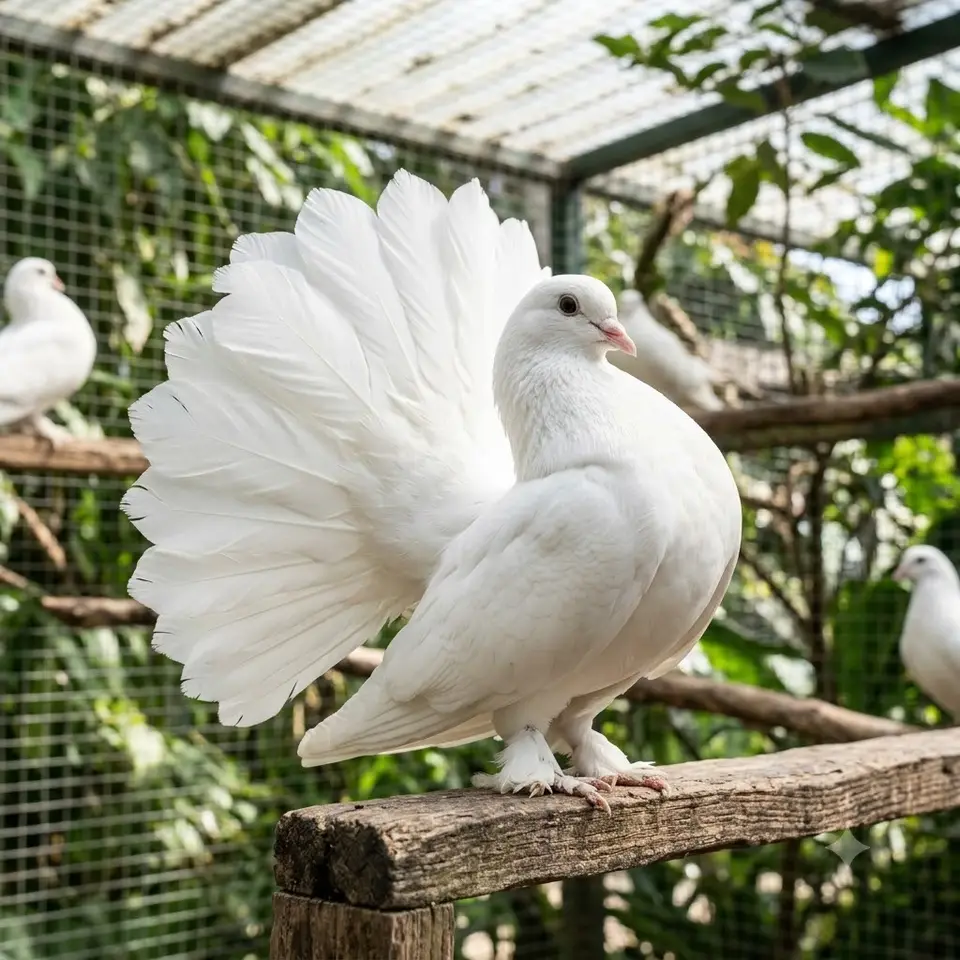
The Fantail is a small ornamental pigeon breed whose tail fans into an upright shell of 30-40 feathers while it struts with its head thrown back over its shoulders.
Last reviewed: October 2026
 AI illustration
 Overview
The Fantail is a small ornamental pigeon breed whose tail fans into an upright shell of 30-40 feathers while it struts with its head thrown back over its shoulders. Purely decorative and delightfully theatrical, it is one of the most popular aviary and show pigeons in the world.
Natural History & Origin
An ancient ornamental fancy breed from India, refined in Europe; kept purely for beauty and show for centuries.
Appearance
Small and dainty (250-350 g) with the signature fanned, upright tail and an arched, chest-out posture; comes in white, and many colours and laced patterns. The head often rests back against the raised tail.
Temperament & Noise
Gentle, ornamental and fairly tame, though flightier than a King; they tame with handling but are kept more to admire than to cuddle. Soft cooing, low noise.
Housing & Flight
An aviary or loft bird above all - the fanned tail hampers strong flight, so they need a safe, enclosed space (they're vulnerable to predators and weather) with low perches and generous floor room. Keep the aviary dry; the tail drags and soils easily.
Diet
Standard pigeon seed mix, pellets, grit, greens and calcium; fresh water and bathing dishes. Nothing unusual beyond keeping food clean, as the tail can sweep the floor.
Health & Lifespan
Average lifespan is 10-15 years. Hardy 10-15 year birds; the main issues are soiled/broken tail feathers, vulnerability outdoors due to poor flight, and the usual canker/worms. Trimming soiled vent feathers helps hygiene and breeding.
Training & Enrichment
Less about tricks, more about display; they can be hand-tamed for shows. Enrichment is a companion, nesting opportunities and space to strut.
Pros & Cons
Pros
- Spectacular ornamental tail and posture
- Small, gentle and quiet
- Long-lived, classic aviary bird
- Peaceful in mixed pigeon lofts
Cons
- Poor flyer: vulnerable, aviary-only
- Tail soils and breaks easily
- More to admire than to handle
- Best in pairs/groups
Best Suited For
- Ornamental aviary keepers
- Pigeon-show hobbyists
- People wanting living garden-aviary beauty
- Keepers with predator-proof space
Everyday gear for birds
Links go to Amazon or a partner brand's own store and may earn us a commission at no extra cost to you. As an Amazon Associate we earn from qualifying purchases. An Amazon link leads to a type of gear and you choose the exact product; a card that names a store leads to that partner's own shop.
Fantail Pigeon - frequently asked questions
Can Fantails fly?
Only weakly - the big upright tail spoils their aerodynamics, so they must be kept safe in an aviary or loft and cannot free-fly like homing pigeons.
Why does it hold its head back?
It's the bred posture: a show Fantail arches its neck so the head rests against the raised tail fan, chest thrown forward - pure ornamental styling.
Are they good pets or just for show?
Both - they hand-tame nicely and are gentle, but they're admired more than handled. For a cuddly pigeon, a King is closer; for beauty, the Fantail wins.
Test yourself: guess the bird
Three clues from our quiz bank, each about another of our birds. Can you name them?
Clue 1.Sold in bright peach-faced and masked varieties, this little hookbill can become nippy without daily attention.
It's the Lovebird - read the full profile →
Clue 2.This is the largest type of parrot kept as a pet, with a long sweeping tail and a huge nut-cracking beak.
It's the Macaw - read the full profile →
Clue 3.Named for its trembling, bobbing courtship motions, this gray-breasted parrot is a gifted talker for its small size.
It's the Quaker (Monk) Parakeet - read the full profile →
Social Needs
Flock and pair birds - they show and breed best in company, and a lone Fantail is a lonely one. They mix peacefully in a mixed pigeon aviary.