Mobility Aids for Aging Pets
Ramps, pet steps, support harnesses, and wheelchairs compared: which aid fits which problem, honest sizing guidance, and how to train a pet to actually use them.
Not veterinary advice. This is general information only - for anything medical, your vet is the right person to ask.
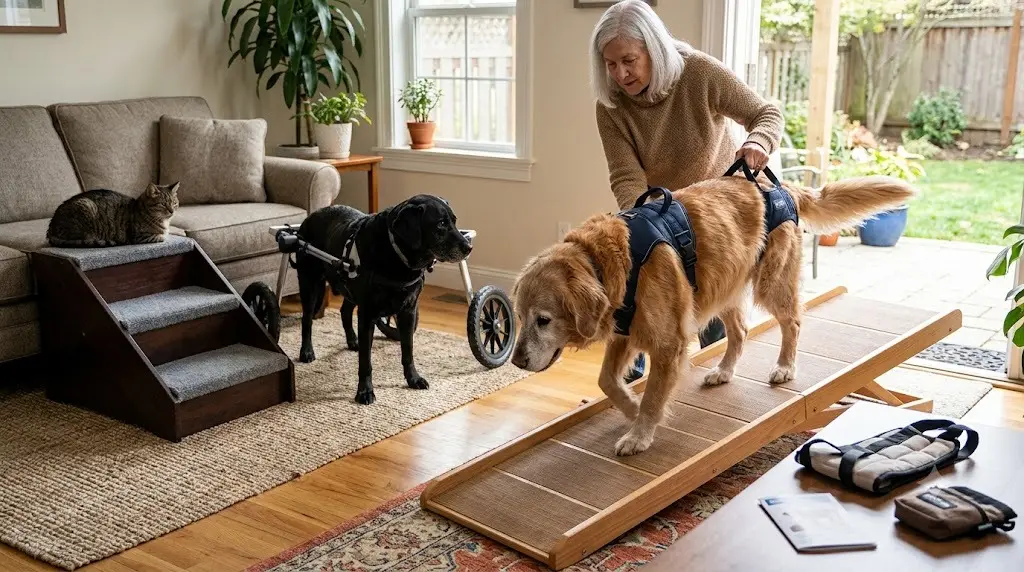
The right mobility aid depends on what your pet can still do: ramps and steps are for pets who move fine but should stop jumping; support harnesses are for pets who need help on stairs, on slick floors, or getting up; wheelchairs are for pets whose hind legs can no longer carry them but who are otherwise bright and willing. Match the aid to the ability, buy it slightly before it is desperately needed, and train it with food - that is the whole game. Here is how to choose within each category.
Start With the Problem, Not the Product
Before buying anything, watch your pet for a few days and name the actual difficulty:
| What you see | What usually helps |
|---|---|
| Hesitates jumping onto couch/bed/car | Ramp or pet steps |
| Slips on hard floors | Rugs first, then traction aids |
| Struggles to stand up from lying | Support harness with handle |
| Wobbly or weak on stairs | Harness, stair gates, carrying for small pets |
| Hind legs collapsing or dragging | Vet visit first, then sling or wheelchair conversation |
That last row matters: sudden hind-end weakness, dragging paws, or knuckling (standing on the top of the paw) are neurological red flags that need a vet before any shopping. Aids compensate for known problems; they should not replace a diagnosis. If you are still narrowing down what is going on, our problem solver can help you organize the symptoms first.
Ramps vs Steps
Both exist to eliminate jumping - the down-jump especially, which loads the front legs on landing. Which one depends on the pet and the location.
Ramps suit dogs with real joint pain (a ramp is a smooth walk; steps still require small hops), long-backed breeds like Dachshunds and Corgis, whose owners are commonly advised to limit jumping, larger dogs, and cars. Look for:
- Gentle incline. This is the spec people miss. The gentler the slope, the easier it is for a stiff dog, and for a given height only a longer ramp gives a gentler slope - so for an SUV, buy the long one.
- Grip surface. Rubberized or carpet-like texture; bare plastic gets skipped or slid down.
- Width and stability. Wide enough for your dog to walk naturally, no flex or wobble under full weight, and a weight rating comfortably above your dog.
- For cars: folding weight. You will lift this thing every trip. Check the ramp’s own weight in the listing: a heavy one tends to stay in the garage.
Pet steps suit smaller pets, cats, tight bedroom spaces, and pets who are stiff but not truly painful. Look for a low rise per step, a deep tread so the whole pet fits on each step, and a non-slip base. Foam steps are quiet but must be dense enough not to squish and wobble - a pet that feels the steps move under it will refuse them.
For beds and couches, either works. For cars, ramps win almost every time. Detailed picks and sizing for specific breeds live in our dog guides.
Support Harnesses and Slings
This category covers everything from “occasional help on stairs” to “daily lifting,” and buying the right level saves money and frustration.
- Handle harnesses (worn all day): a normal walking harness with a sturdy handle over the shoulders or back. For pets who mostly manage but need a steadying hand on stairs, into cars, or up from slippery floors. If your dog needs help a few times a day, this beats grabbing them under the belly every time - better for their joints and your back.
- Rear-support slings: a padded band under the belly or hips with handles up top. For dogs with weak hindquarters who walk but wobble. Cheap, effective, easy to stash by the stairs. The trade-off: most must be put on for each use, and males can be tricky to fit without interfering with peeing - look for cutaway designs.
- Full-body support harnesses: front and rear sections with lifting handles, worn for extended periods. For significantly impaired dogs - post-surgery recovery, degenerative conditions - where you are assisting many times a day. More expensive, but load-bearing and comfortable for the dog, which the towel-under-the-belly trick is not for more than a day or two.
Fit notes: you want snug without chafing at the armpits and groin, padding wide enough to spread the load (a thin strap digs), and handles positioned so you can walk upright beside the dog. Check for rub marks daily the first week.
Wheelchairs (Carts)
A dog wheelchair - more accurately a rear-support cart - suits dogs whose hind legs can no longer reliably carry them but who are alert, willing, and strong in front. Common candidates include dogs with degenerative conditions, and this is emphatically a decision to make with your vet, both for timing and for fit.
Honest expectations:
- Most rear carts require decent front-leg strength; the dog drives with the front and the cart carries the rear. Full-support (4-wheel) carts exist for weaker dogs.
- Measurement matters enormously. Carts are sized by height to the hip, length, and weight; an ill-fitting cart chafes and gets refused. Adjustable carts are more forgiving for first-timers.
- Cost varies widely with size and adjustability. Rescues and rehab clinics sometimes rent or lend - worth asking before buying.
- Carts are outdoor and supervised-time tools, not all-day equipment. Dogs should not be left in them unattended, and most cannot lie down in a rear cart.
- Some dogs take to a cart quickly, because the reward - moving again - is immediate. Others need patient, short sessions.
Traction Aids: The Unsung Category
Sometimes the “mobility aid” your pet needs is just grip. Runner rugs along main routes are the first and best fix. Beyond that: traction socks (short lifespan, but useful indoors), rubber-soled booties, and adhesive nail grips for dogs. Two free upgrades that owners skip: keep nails genuinely short, and trim the fur growing between paw pads - shaggy paw fur on hardwood is like wearing ski socks on tile.
Training: How to Get a Pet to Actually Use These Things
Most “my dog refuses the ramp” stories are training stories, and the pattern is the same for every aid.
- Introduce it flat and inert. Ramp flat on the floor, steps against a wall, harness lying on the ground near the food bowl. Let the pet investigate; treat any interest. One or two days of this.
- Reward interaction, not use. Paws on the flat ramp earns a treat. Walking across the flat ramp earns several. No luring the pet up an incline yet.
- Raise the difficulty in small steps. Ramp against the first stair, then against the couch. For harnesses: wear it 10 minutes with treats, then during meals, then add the handle pressure gently.
- Never force, never rush a fearful pet, and control the exit. A single slide or stumble can undo a week of goodwill. Spot them the first several real uses.
- Make it the only route. Once trained, block the jump temporarily (a laundry basket on the launch spot works) so the ramp becomes the default rather than the alternative.
Timeline: some pets take to a ramp in a day; cautious seniors need longer, in short sessions. Go at the pet’s pace.
When to Buy
Earlier than feels necessary. A ramp introduced while your dog still jumps easily is learned without fear. The same ramp introduced after a painful failed jump has fear attached to it. If your pet is a senior and furniture or cars are part of daily life, the ramp or steps are already worth it - and a weight-appropriate model choice starts with the sizing tools in our tools section.
The Short Version
- Match the aid to ability: ramps/steps to stop jumping, harnesses for assistance, carts when hind legs fail but spirit does not.
- Sudden weakness or paw-dragging means vet first, shopping second.
- Ramps: long and shallow, grippy, stable. Steps: low rise, deep tread, no wobble.
- Harnesses: buy the support level you actually use daily; padding width is comfort.
- Train everything flat-first, food-forward, never forced - and buy before the crisis, not after.
Recommended Gear on Amazon
- Lifting harness - browse current options and reviews on Amazon.
- Pet ramp - browse current options and reviews on Amazon.
- Non-slip floor runners - browse current options and reviews on Amazon.
As an Amazon Associate, we earn from qualifying purchases - at no extra cost to you. This helps us keep producing free, in-depth guides.